The Top Dividend Yields Right Now: Who Is Safe and Who Is a Trap
High yields often signal high risk. We analyze the sustainability of top-yielding stocks to help you build a resilient income portfolio.

Why these yields right now
Market volatility has pushed yields for several major companies above the 9% threshold, creating a complex environment for income-focused investors. While high yields are attractive in a high-interest-rate environment, they frequently reflect depressed share prices rather than fundamental strength.
Investors must distinguish between companies with structural cash flow issues and those experiencing temporary market mispricing. A yield exceeding 9% often serves as a warning sign that the market expects a dividend reduction or is pricing in significant earnings contraction.
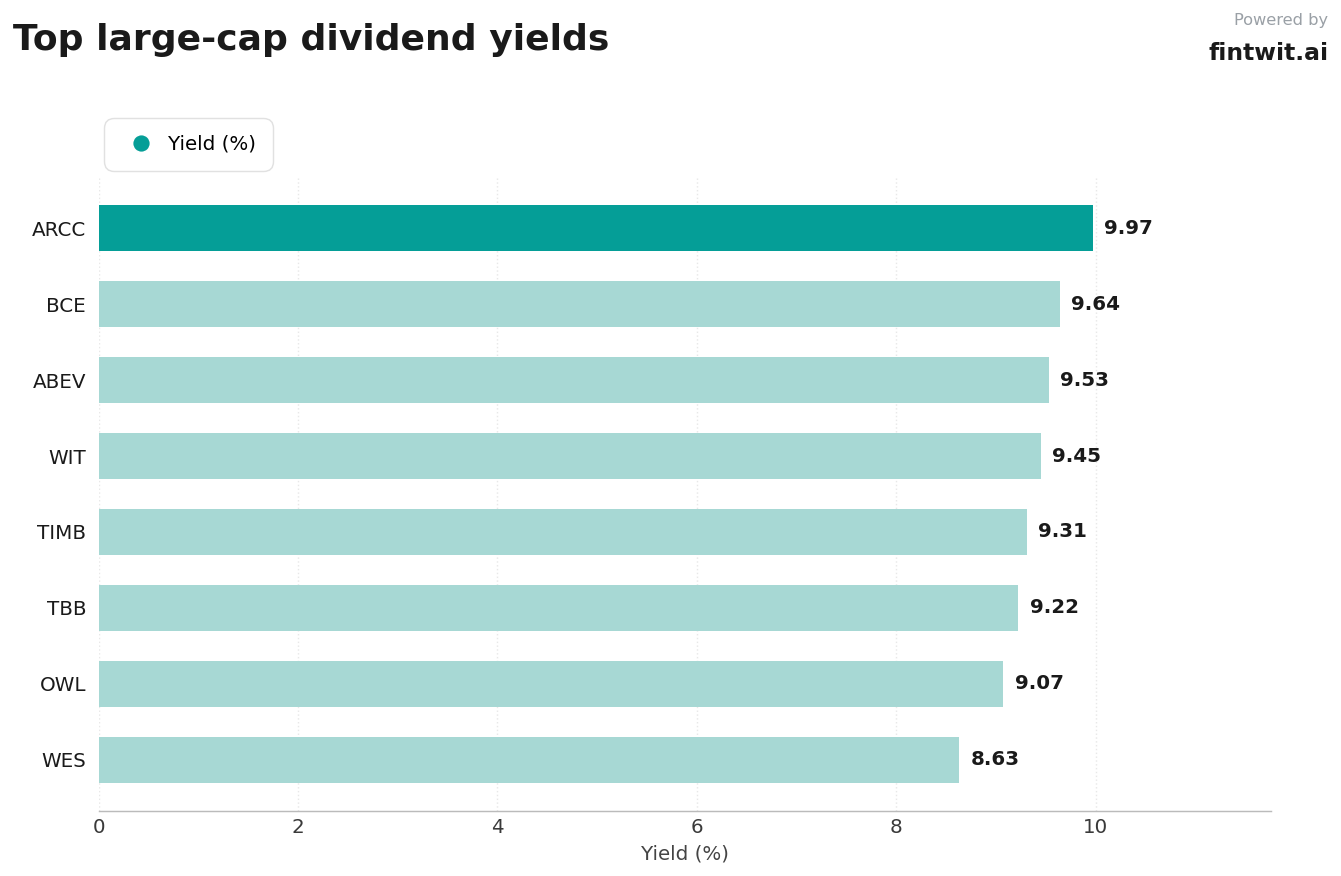
- ARCC maintains a 9.97% yield, supported by a 16-year history of dividend stability.
- BCE Inc. reset its dividend in 2025, resulting in a current yield of 9.64%.
- Ambev SA (ABEV) offers a 9.53% yield, though its TTM payout ratio stands at 173.68%.
- Wipro (WIT) provides a 9.45% yield alongside a significant share buyback program announced in April 2026.
- TIM Participacoes (TIMB) yields 9.31% with a volatile payment schedule.
- AT&T (T) yields 9.22% following a 2022 spin-off and subsequent dividend reset.
- Blue Owl Capital (OWL) yields 9.07% despite an earnings miss and high payout metrics.
- Western Midstream (WES) yields 8.63% following a dividend increase in May 2026.
The top yielders
Evaluating the safety of these yields requires looking beyond the headline percentage. A payout ratio exceeding 100% is a primary indicator that the company is paying out more than it earns, which is unsustainable without significant cash reserves or debt financing.
The following list details the current yield, payout ratio, and safety assessment for the most prominent high-yielders in the current market.
- ARCC: 9.97% yield, 119.26% payout ratio, high risk.
- BCE: 9.64% yield, 26-64% payout ratio, sustainable.
- ABEV: 9.53% yield, 173.68% payout ratio, low safety.
- WIT: 9.45% yield, 81-84% payout ratio, moderate safety.
- TIMB: 9.31% yield, 67-351% payout ratio, moderate safety.
- T: 9.22% yield, 37-51% payout ratio, high safety.
- OWL: 9.07% yield, 675-692% payout ratio, very low safety.
- WES: 8.63% yield, 105-124% payout ratio, low safety.
Yield traps
A yield trap occurs when a stock's high dividend yield is a symptom of a declining business model rather than a reliable income stream. Investors should be wary of companies where the payout ratio consistently exceeds earnings, as this forces management to choose between debt accumulation and dividend cuts.
The following companies exhibit specific risk flags that suggest their current dividend levels may be at risk of future adjustment.
- ARCC: High payout ratio and declining core earnings.
- ABEV: High payout ratio and mixed sustainability outlook.
- OWL: Extremely high payout ratio and dividend sustainability concerns.
- WES: High payout ratio relative to earnings.
- BCE: Structural industry pressures and recent dividend cut history.
Build an income sleeve
Constructing a resilient income sleeve requires balancing high-yield assets with companies that prioritize debt reduction and capital return stability. AT&T (T) represents a more conservative approach, as it has prioritized debt reduction and maintained a stable payout ratio between 37% and 51% since its 2022 reset.
Investors should avoid concentrating capital in sectors with high payout ratios, such as asset management or midstream energy, unless they have a high tolerance for dividend volatility. Diversification across sectors like telecom and technology can mitigate the risk of a single dividend cut impacting the entire portfolio.
- Prioritize companies with payout ratios below 60% for long-term income stability.
- Monitor quarterly earnings reports for changes in payout policy, particularly for firms with ratios above 100%.
- Use share buybacks as a secondary indicator of management's confidence in cash flow, as seen with Wipro's April 2026 announcement.