The top dividend yields right now: who's safe, who's a trap
High yields often signal distress. We analyze the sustainability of top-yielding stocks to separate reliable income from potential dividend traps.

Why these yields right now
Current market conditions have pushed yields for several sectors into the 8% to 10% range. This phenomenon is driven by a combination of sector-specific headwinds, such as the capital-intensive nature of telecommunications, and broader interest rate sensitivity in asset management.
A high yield is not inherently a sign of a bad company, but it is a signal that the market is pricing in significant risk. Investors must distinguish between companies resetting their capital allocation strategies and those facing structural decline.
The top yielders
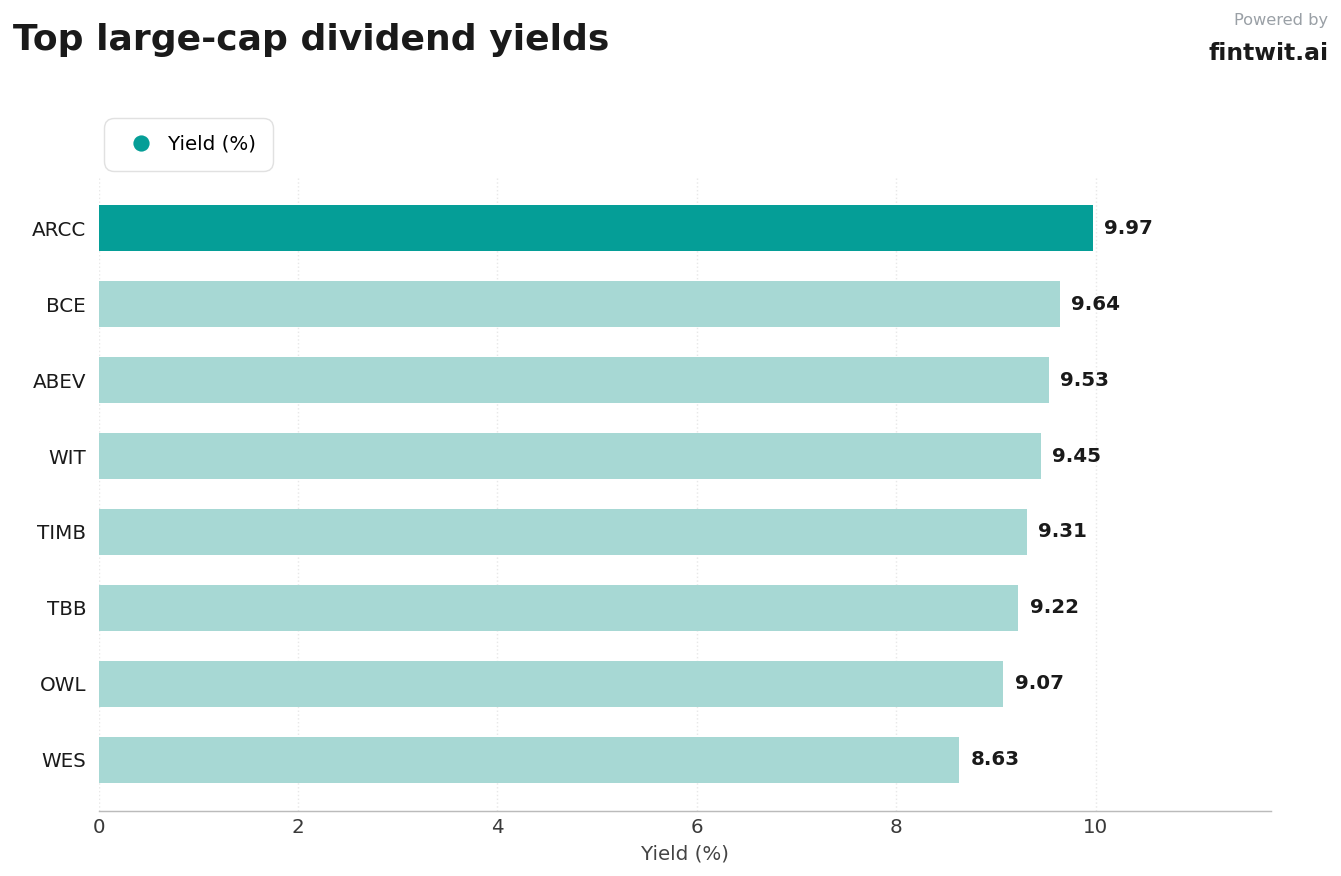
The following list highlights companies currently offering yields exceeding 8.5%. Sustainability varies significantly based on free cash flow coverage rather than simple earnings-based payout ratios.
Investors should prioritize cash flow metrics over GAAP earnings when evaluating these specific entities.
- Ares Capital (ARCC): 9.97% yield, 117.79% payout ratio, High safety risk.
- BCE Inc (BCE): 9.64% yield, 25.85% payout ratio, Improved safety.
- Ambev SA (ABEV): 9.53% yield, 173.68% payout ratio, Low safety.
- Wipro Limited (WIT): 9.45% yield, 84.2% payout ratio, Moderate safety.
- TIM Participacoes (TIMB): 9.31% yield, 351.56% payout ratio, Low safety.
- AT&T (T): 9.22% yield, 37.25% payout ratio, High safety.
- Blue Owl Capital (OWL): 9.07% yield, 692.3% payout ratio, Low safety.
- Western Midstream (WES): 8.63% yield, 121.57% payout ratio, Moderate safety.
Yield traps
A yield trap occurs when a stock's dividend yield appears attractive but is unsustainable due to deteriorating fundamentals. These companies often pay out more than they earn, forcing a reliance on debt or asset sales to maintain distributions.
The following tickers exhibit high risk flags based on current payout structures and operational performance.
- ABEV: Payout ratio of 173.68% significantly exceeds earnings, creating sustainability concerns.
- TIMB: Extremely high payout ratio of 351.56% suggests high volatility in future distributions.
- OWL: Payout ratio of 692.3% creates significant pressure from private credit market volatility.
- BCE: Recent history of a 50% dividend cut in 2025 highlights operational challenges in the Canadian telecom market.
Build an income sleeve
Constructing a resilient income sleeve requires balancing high-yield assets with those that demonstrate consistent cash flow coverage. Relying solely on the highest yielders often exposes a portfolio to dividend cuts that can permanently impair capital.
Focus on companies like AT&T, which maintains a 2.38x free cash flow coverage ratio, to anchor the portfolio. Diversify across sectors to mitigate the impact of industry-specific downturns, such as those currently affecting the telecom and asset management spaces.