Walt Disney Company (DIS) vs Netflix Inc (NFLX): Which Is the Better Buy in 2026?
Disney's legacy transition versus Netflix's streaming dominance: A head-to-head financial comparison of two media titans.
The matchup
The entertainment landscape is bifurcated between legacy media conglomerates and pure-play streaming platforms. Disney operates a complex, diversified ecosystem that relies on the synergy between its theme parks, film studios, and emerging direct-to-consumer services.
Netflix maintains a singular focus on global streaming, leveraging a massive data-driven content engine to drive engagement. While Disney attempts to bridge the gap between physical experiences and digital media, Netflix is scaling its ad-supported tier to capture incremental revenue.
- Disney's moat is built on iconic IP like Marvel and Star Wars, which fuels its parks and merchandise segments.
- Netflix holds a first-mover advantage in streaming, supported by a global subscriber base that provides significant operating leverage.
- Disney is currently navigating a high-stakes transition of ESPN into a standalone digital service.
- Netflix is prioritizing margin expansion, which reached 32.3% in Q1 2026, through operational efficiency and ad-tier scaling.
Numbers side by side
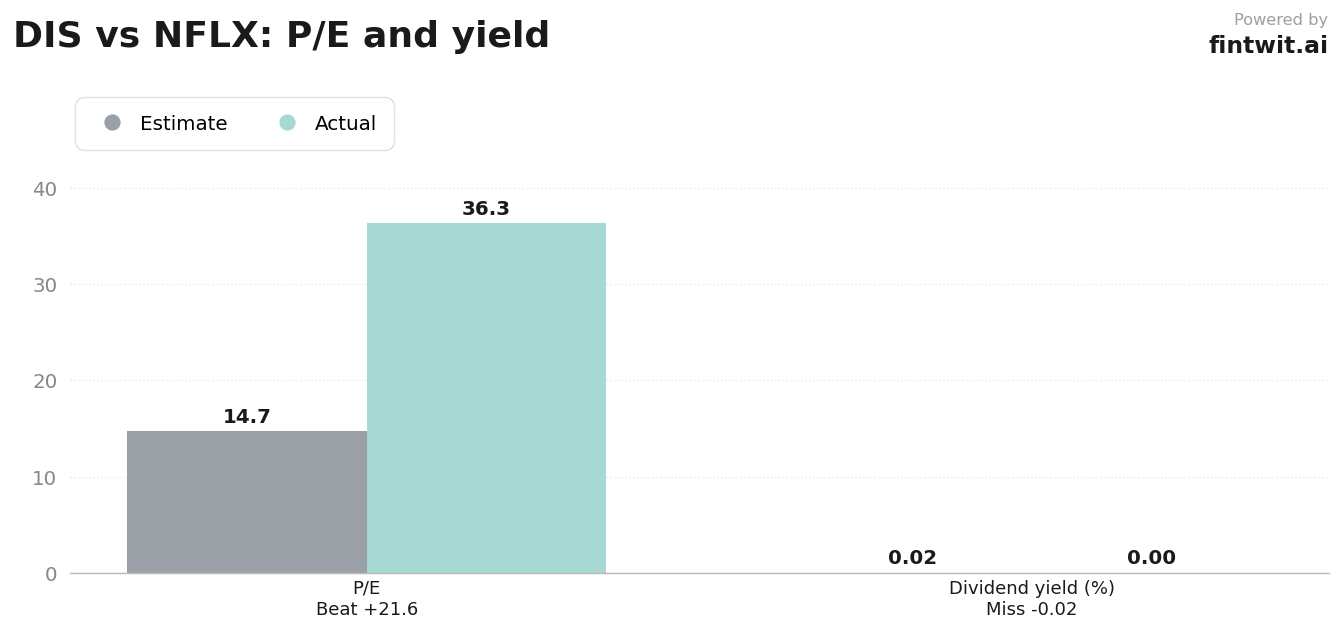
Valuation metrics highlight the different growth profiles and market expectations for these two companies. Disney trades at a lower P/E ratio, reflecting the market's caution regarding its legacy assets, while Netflix commands a premium for its consistent top-line expansion.
The following data points illustrate the current financial standing of both firms as of Q1 2026.
- Disney P/E Ratio: 14.70
- Netflix P/E Ratio: 36.29
- Disney Revenue Growth: 5% YoY
- Netflix Revenue Growth: 16.2% YoY
- Disney Dividend Yield: 1.51%
- Netflix Dividend Yield: 0.00%
- Disney 1-Year Price Return: -8.08%
- Netflix 1-Year Price Return: -27.63%
Bull and bear on each
Analysts remain divided on the pace of recovery for Disney and the long-term growth ceiling for Netflix. The bull cases center on operational pivots, while bear cases focus on macroeconomic sensitivity and regulatory risks.
Below are the primary drivers for both tickers according to current market consensus.
- Disney Bull: Successful launch of ESPN as a standalone DTC service.
- Disney Bull: Strong cash flow from Experiences segment supporting buybacks.
- Disney Bear: Accelerating decline of high-margin linear TV networks.
- Disney Bear: Macroeconomic sensitivity impacting theme park attendance.
- Netflix Bull: Rapid scaling of the ad-supported tier and internal ad-tech.
- Netflix Bull: Dominant global subscriber base with high engagement.
- Netflix Bear: Regulatory scrutiny regarding market power and content influence.
- Netflix Bear: High content cost inflation pressuring operating margins.
- Citigroup analyst Jason Bazinet maintains a Buy rating on Disney with a $145.00 target.
- B of A Securities analyst Jessica Reif Ehrlich maintains a Buy rating on Netflix with a $125.00 target.
The verdict
Choosing between these two entertainment giants requires a decision on whether you prefer the stability of a diversified legacy conglomerate or the aggressive growth of a streaming pure-play. Disney offers a unique value proposition through its physical assets, while Netflix provides a cleaner, albeit more expensive, exposure to the future of digital entertainment.
Investors should weigh the structural challenges of linear television against the potential for margin expansion in the streaming sector. Both companies are currently positioned to benefit from their respective strategic pivots, though the execution risks remain distinct for each management team.