The Top Dividend Yields Right Now: Who Is Safe and Who Is a Trap
High yields often signal market skepticism. We break down the dividend safety of top yielders like ARCC, BCE, and T to identify sustainable income.

Why these yields right now
The current market environment has pushed dividend yields to levels not seen in years, driven by sector-specific volatility and interest rate sensitivity. Investors are increasingly looking for income to offset inflationary pressures, yet high yields often reflect significant underlying risk.
A yield exceeding 9% is rarely a sign of a stable, growing business. It is frequently a market signal that the stock price has collapsed due to fears of a dividend cut or deteriorating fundamentals.
Evaluating these yields requires looking beyond the headline percentage. We focus on the payout ratio relative to free cash flow rather than accounting earnings, which can be distorted by non-cash charges.
The top yielders
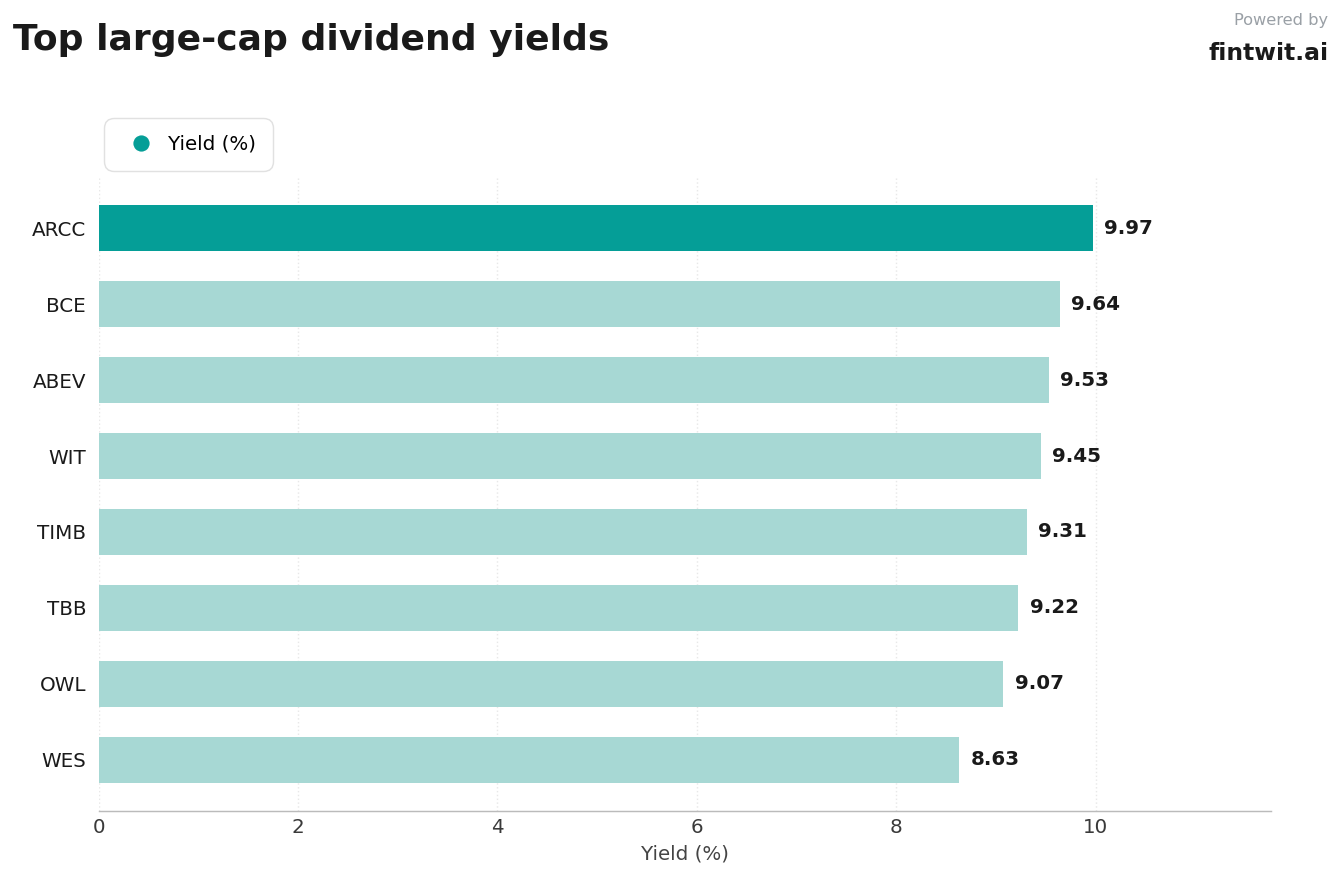
The following list highlights companies currently offering yields above 8.5%. Safety ratings are based on the ability of cash flows to cover distributions.
Investors should prioritize companies with a history of dividend growth or a clear management commitment to maintaining payouts despite earnings fluctuations.
- Ares Capital (ARCC): 9.97% yield, 117.79% payout ratio, High risk.
- BCE Inc (BCE): 9.64% yield, 25.85% payout ratio, Moderate risk.
- Ambev SA (ABEV): 9.53% yield, 173.68% payout ratio, High risk.
- Wipro Limited (WIT): 9.45% yield, 85.73% payout ratio, Moderate risk.
- TIM Participacoes (TIMB): 9.31% yield, 351.56% payout ratio, High risk.
- AT&T Inc (T): 9.22% yield, 37.73% payout ratio, Low risk.
- Blue Owl Capital (OWL): 9.07% yield, 758.67% payout ratio, High risk.
- Western Midstream (WES): 8.63% yield, 121.57% payout ratio, Moderate risk.
Yield traps
A yield trap occurs when a stock's high dividend is unsustainable and likely to be cut, leading to both a loss of income and capital depreciation. We identify these by analyzing payout ratios that exceed 100% of earnings or cash flow.
Companies with high payout ratios often lack the financial flexibility to navigate economic downturns. When a company pays out more than it earns, it must rely on debt or asset sales to sustain the dividend, which is inherently temporary.
- Ares Capital (ARCC): High risk due to core earnings dipping below the dividend payout level.
- Ambev SA (ABEV): High risk due to an unsustainable 173.68% payout ratio.
- TIM Participacoes (TIMB): High risk due to an extreme 351.56% payout ratio.
- Blue Owl Capital (OWL): High risk as current distributable earnings fail to cover the dividend.
Build an income sleeve
Constructing a resilient income portfolio requires balancing high-yield assets with those that offer dividend growth and safety. AT&T (T) stands out as a low-risk option, having reset its dividend in 2022 and now covering it comfortably with cash flow.
Western Midstream (WES) provides a moderate-risk alternative with five consecutive years of dividend growth. Its reliance on distributable cash flow rather than net income makes its 8.63% yield more defensible than peers with higher earnings-based payout ratios.
Diversification across sectors is essential. Relying solely on telecom or asset management exposes an income sleeve to concentrated regulatory or interest rate risks.