Visa Inc. (V) vs Mastercard Inc. (MA): Which Is the Better Buy in 2026?
Visa and Mastercard dominate global payments. We compare their 2026 growth, margins, and competitive moats to identify the better long-term buy.
The matchup
Visa and Mastercard operate the world's most critical payment infrastructure, effectively acting as the toll booths for global commerce. Both companies have successfully transitioned from simple card networks to diversified technology platforms.
VisaNet remains the gold standard for scale, while Mastercard has aggressively pivoted toward multi-rail orchestration. Both firms are currently navigating a shift toward real-time payments and account-to-account transfers.
- Visa (V) market cap: $581.5B.
- Mastercard (MA) market cap: $442.9B.
- Visa revenue growth: 17% YoY (Q2 2026).
- Mastercard revenue growth: 16% YoY (Q1 2026).
- Visa value-added services (VAS) growth: 27%.
- Mastercard value-added services (VAS) growth: 22%.
Numbers side by side
The financial profiles of both companies are remarkably similar, characterized by high operating margins and consistent cash flow generation. Visa maintains a slight edge in profitability metrics, while Mastercard trades at a marginally higher valuation multiple.
Investors should note that both companies have faced recent downward price pressure, with Visa down 1.32% and Mastercard down 1.67% in recent sessions. The following data highlights the current valuation and performance gap.
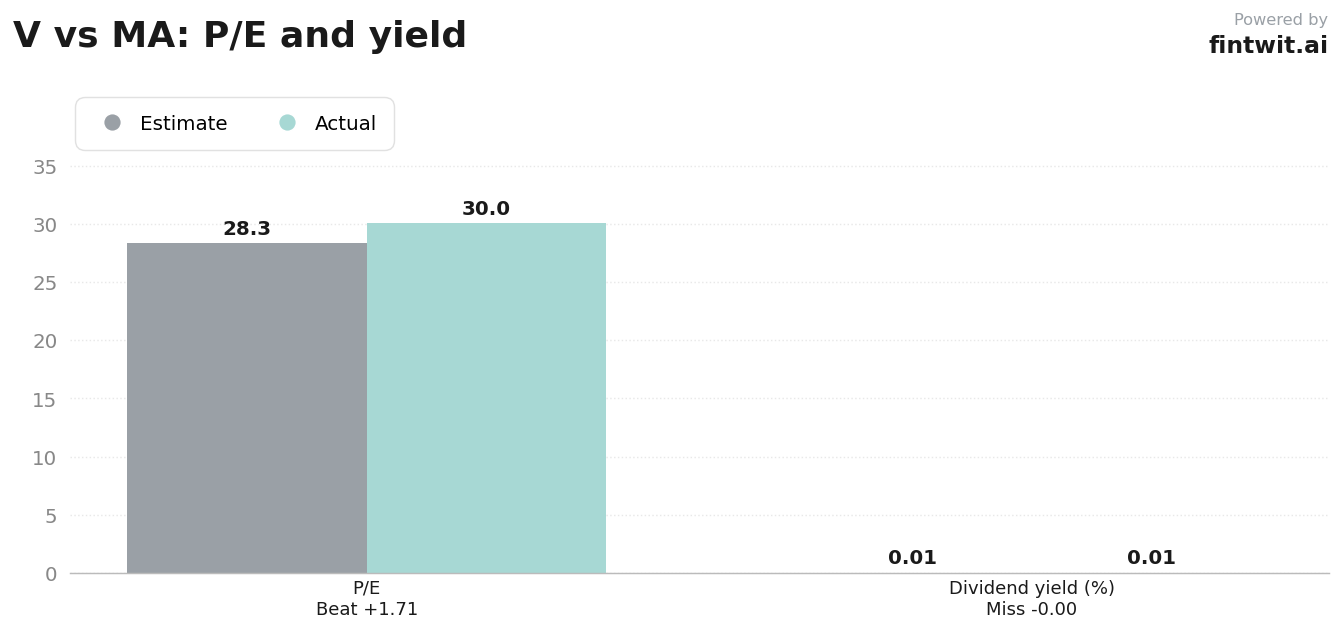
- Visa P/E ratio: 28.32.
- Mastercard P/E ratio: 30.03.
- Visa GAAP operating margin (TTM): 67%.
- Mastercard operating margin (TTM): 59%.
- Visa 90-day price performance: +14.30%.
- Mastercard 90-day price performance: +5.52%.
Bull and bear on each
The bull case for both companies rests on the continued digitization of cash and the expansion of high-margin value-added services. However, regulatory scrutiny regarding interchange fees remains a persistent risk for both.
Visa's strength lies in its massive scale and capital return program, while Mastercard's strength is its agility in international cross-border markets.
- Visa Bull: $20B buyback authorization signals management confidence.
- Visa Bull: Deep integration into global financial institutions creates high switching costs.
- Visa Bear: Structural threat from government-backed real-time rails like FedNow and Pix.
- Visa Bear: Ongoing antitrust scrutiny regarding interchange fee structures.
- Mastercard Bull: Superior exposure to high-growth international travel corridors.
- Mastercard Bull: Successful execution of multi-rail and agentic commerce payment layers.
- Mastercard Bear: Geopolitical volatility impacting cross-border transaction volumes.
- Mastercard Bear: Execution risk associated with stablecoin and AI-driven payment bets.
The verdict
Visa maintains a superior scale advantage and slightly higher margin profile, providing a more defensive, cash-generative core while successfully scaling its VAS engine. Mastercard remains a compelling growth play, particularly if its multi-rail orchestration captures significant non-card payment volume.
The choice between the two depends on whether an investor prioritizes Visa's unmatched margin stability or Mastercard's aggressive international expansion strategy. Both companies are well-positioned to benefit from the long-term secular trend of global digital payment adoption.