The Top Dividend Yields Right Now: Who Is Safe and Who Is a Trap
High yields often signal market distress. We analyze eight high-dividend stocks to distinguish between sustainable income and value traps.

Why these yields right now
Market volatility over the last twelve months has pushed yields for several companies above the 9% threshold. Investors are currently pricing in significant risk premiums, particularly in the telecom and asset management sectors.
A yield above 9% is rarely a sign of a stable, growing business. It is often a mathematical consequence of a declining share price, which forces the yield percentage higher even if the dividend payout remains constant or is cut.
The top yielders
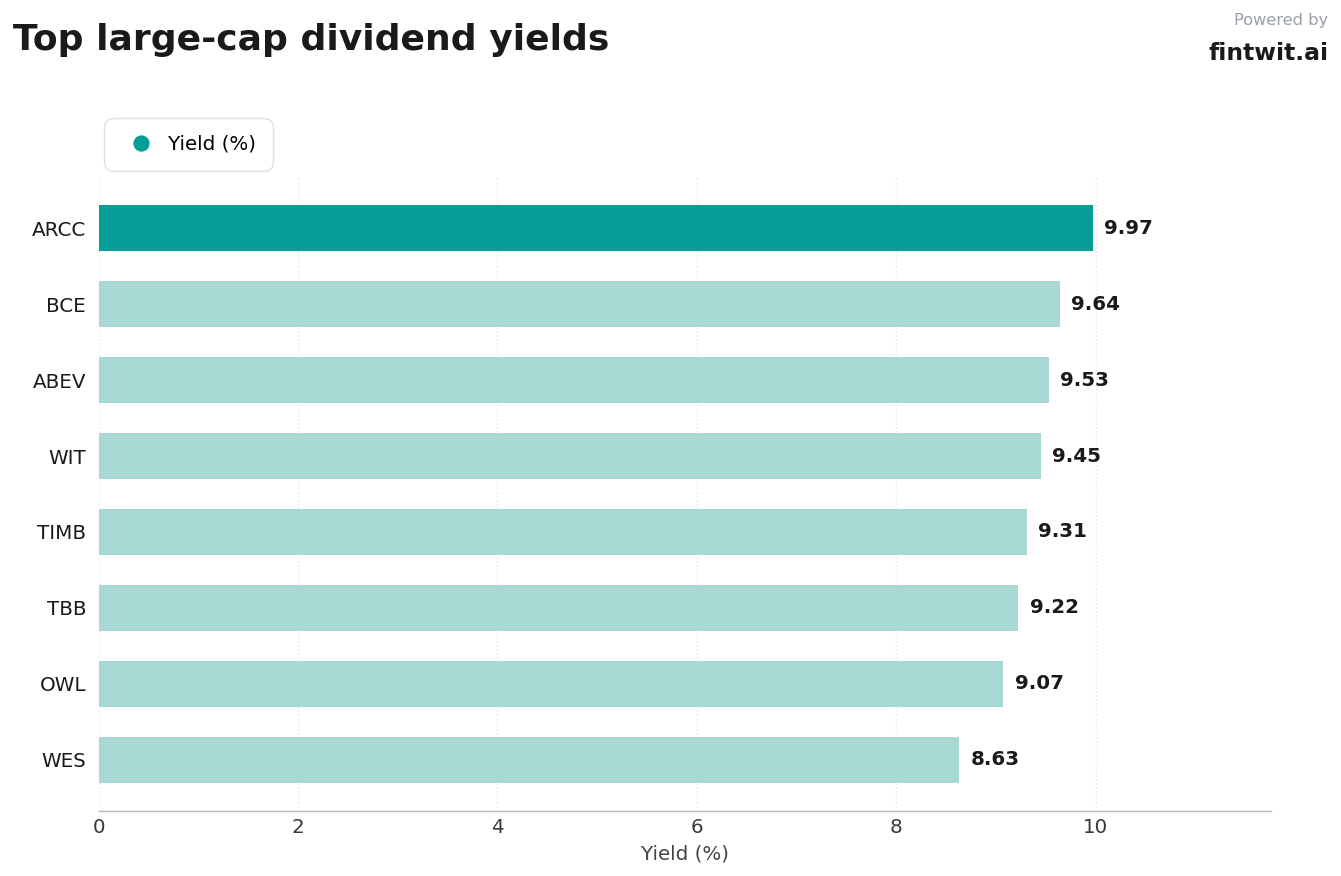
The following list highlights companies currently yielding over 9% based on recent market data. Sustainability varies significantly depending on the underlying business model and cash flow generation.
Investors should prioritize companies with payout ratios below 60% of free cash flow. Ratios exceeding 100% indicate that the company is paying out more than it earns, which is unsustainable without debt financing or asset sales.
- Ares Capital (ARCC): 9.97% yield, 117.79% payout ratio, High risk.
- BCE Inc (BCE): 9.64% yield, 25.81% payout ratio, Low risk.
- Ambev SA (ABEV): 9.53% yield, 69.29% payout ratio, Moderate risk.
- Wipro Limited (WIT): 9.45% yield, 84.69% payout ratio, Moderate risk.
- TIM Participacoes (TIMB): 9.31% yield, Variable payout, High risk.
- AT&T Inc (T): 9.22% yield, 37% payout ratio, Low risk.
- Blue Owl Capital (OWL): 9.07% yield, 125% payout ratio, High risk.
- Western Midstream (WES): 8.63% yield, 103% payout ratio, Moderate risk.
Yield traps
A yield trap occurs when a stock's high dividend yield is offset by a deteriorating business model or a looming dividend cut. These stocks often appear cheap on a trailing basis but are expensive when adjusted for future earnings risk.
Investors must differentiate between a company resetting its dividend for long-term health and one struggling to maintain its payout. BCE, for instance, cut its dividend by over 50% in May 2025 to reset to a sustainable level.
- ARCC: High risk due to payout ratio exceeding 100%.
- TIMB: High risk due to reliance on unpredictable special dividends.
- OWL: High risk due to dividend not being fully covered by cash flow.
Build an income sleeve
Constructing an income sleeve requires balancing high-yield assets with those that demonstrate consistent dividend growth. Relying solely on the highest yields in the market often leads to capital erosion that outweighs the income generated.
Focus on companies like AT&T, which has maintained a stable payout since its 2022 reset. Diversify across sectors to ensure that a single industry downturn does not jeopardize your entire income stream.