Taiwan Semiconductor Manufacturing (TSM) Q2 2026 Earnings Preview: What to Watch
TSM reports Q2 2026 earnings on July 16. Analysts expect strong growth driven by AI demand. Here is the breakdown of consensus, key segments, and risks.
The setup
TSM remains the primary bellwether for global semiconductor demand, particularly within the High-Performance Computing (HPC) sector. Management previously provided Q2 2026 revenue guidance of $39.0 billion to $40.2 billion, with gross margins targeted between 65.5% and 67.5%.
The company has maintained a full-year 2026 revenue growth projection of over 30% in USD terms. Capital expenditure remains at the high end of the $52 billion to $56 billion range as the firm accelerates capacity for advanced nodes.
- Jeff Pu of GF Securities maintains a bullish stance with a target of NT$2,900, citing potential for raised guidance.
- Laura Chen at Citi expects higher wafer pricing for 2nm and 3nm nodes to drive margin expansion, setting a target of NT$3,800.
- Simon Coles of Barclays holds a Buy rating with a $625 target, emphasizing the durability of advanced technology demand.
- Macro headwinds include geopolitical supply chain risks and USD/NTD exchange rate volatility impacting reported margins.
Consensus numbers
Market consensus anticipates a strong quarter, with analysts looking for EPS of $3.83 and revenue of approximately $39.6 billion. This performance would reflect the continued scaling of AI-driven HPC demand.
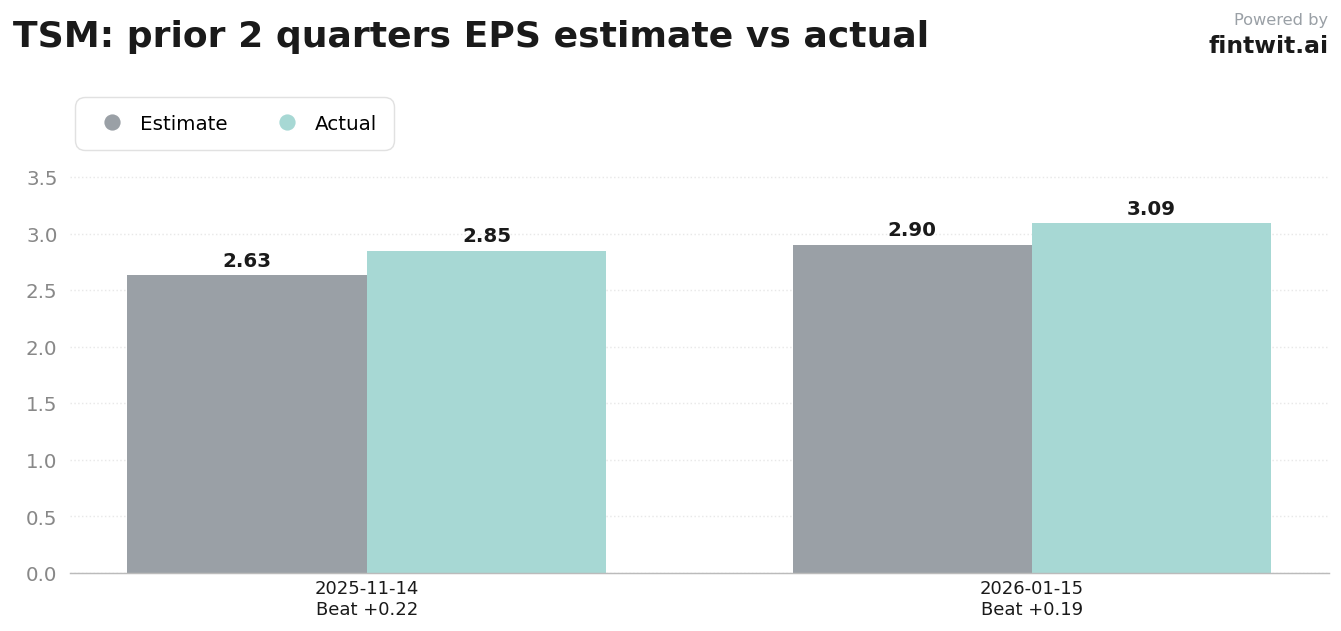
The company has a history of exceeding expectations, as evidenced by the performance in late 2025 and early 2026.
- Consensus EPS Estimate: $3.83
- Consensus Revenue Estimate: $39.6 billion
- Q4 2025 Actual EPS: $2.85 vs $2.63 estimated
- Q1 2026 Actual EPS: $3.09 vs $2.90 estimated
- HPC Segment: 61% of Q1 revenue, serving as the primary growth engine.
What we'll watch on the call
Investors are looking for clarity on whether the current 30%+ revenue growth guidance for 2026 will be revised upward. The sustainability of hyperscaler infrastructure spending remains the most significant variable for the second half of the year.
Operational efficiency at advanced nodes is also under scrutiny. Management commentary on 3nm gross margin progression toward the corporate average will be a critical indicator of long-term profitability.
- Status of CoWoS capacity expansion and identification of remaining production bottlenecks.
- Potential for further wafer price hikes to offset rising costs and support margin expansion.
- Demand trends in smartphone and consumer segments to gauge the breadth of the semiconductor recovery.
- Updates on 2027 capital expenditure plans to support long-term node transition.
Fintwit's AI verdict
The sentiment surrounding TSM has shifted toward a high-conviction outlook as the company cements its role as the sole provider for the most advanced AI silicon. Quantitative models suggest that the current valuation does not fully account for the margin expansion potential inherent in the 2nm and 3nm ramp-up.
While geopolitical risks remain a constant factor in the pricing of the stock, the fundamental demand profile appears to outweigh these concerns for institutional participants. The upcoming earnings call will likely serve as a catalyst for re-rating the stock based on updated capacity and pricing power metrics.