The top dividend yields right now: who's safe, who's a trap
High yields often signal distress. We evaluate the safety of current market leaders and identify which payouts are sustainable versus those at risk of cuts.

Why these yields right now
The current market environment has pushed dividend yields to levels not seen in a decade for several sectors. High interest rates have increased the cost of capital, forcing companies to choose between servicing debt and maintaining shareholder distributions.
Investors must distinguish between yields driven by fundamental business strength and those inflated by significant share price declines. A yield above 8% often serves as a market signal that the equity risk premium has expanded due to underlying operational concerns.
Capital allocation frameworks are shifting across the board. Management teams are increasingly prioritizing balance sheet health over historical dividend growth streaks to avoid credit rating downgrades.
- The average yield for the provided list of high-dividend stocks currently sits above 9.2%.
- Asset managers like Ares Capital (ARCC) maintain yields near 9.97% despite broader financial sector volatility.
- Telecom operators are undergoing structural shifts, with BCE resetting its payout ratio to 40-55% of free cash flow.
The top yielders
Identifying sustainable income requires looking beyond the headline yield percentage. We evaluate these companies based on their ability to generate sufficient free cash flow to cover distributions without relying on external financing.
The following list represents a cross-section of high-yield opportunities across energy, finance, and consumer sectors. Investors should note that payout ratios are the primary metric for determining the longevity of these payments.
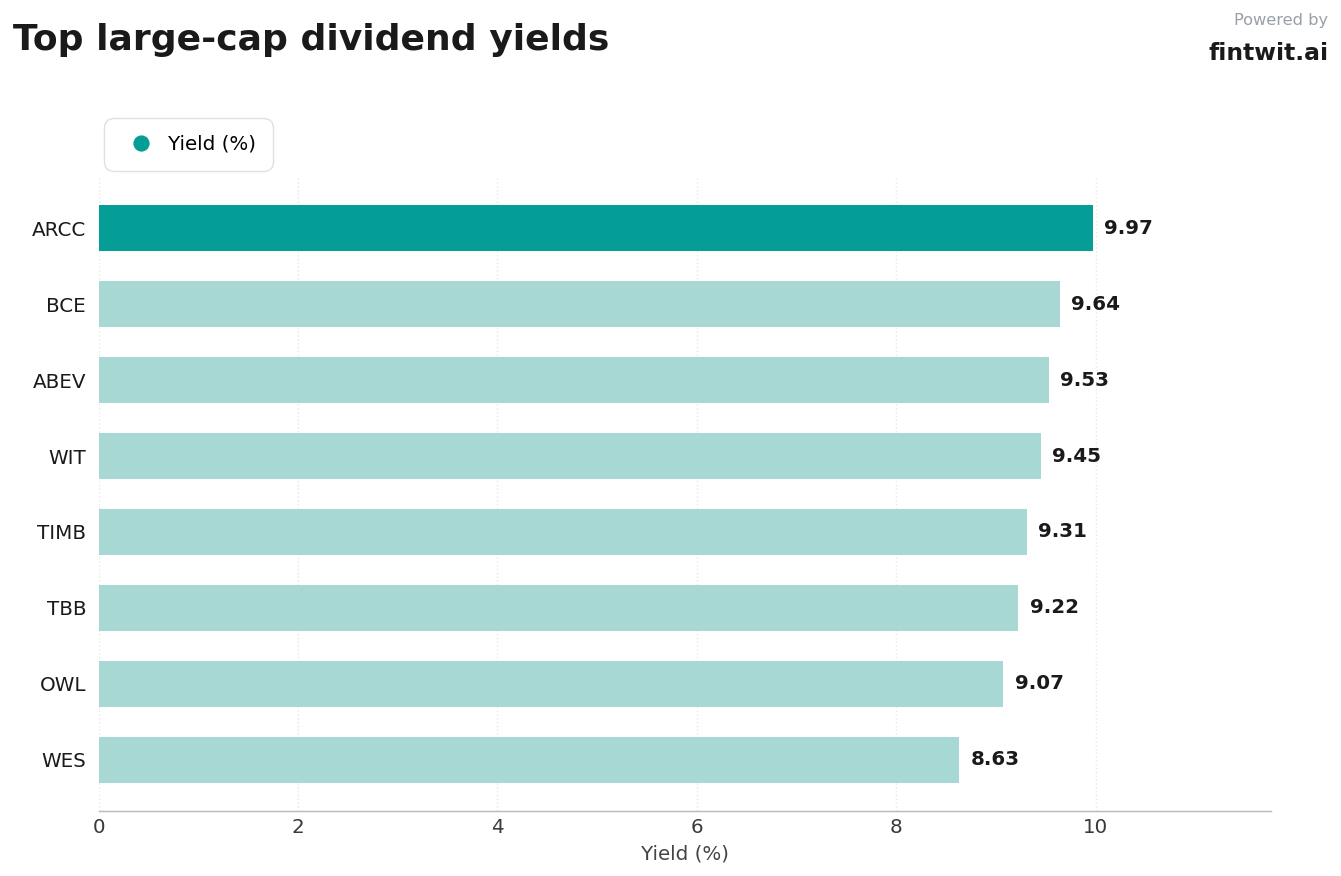
The data below highlights the current market pricing and yield profiles for these specific tickers.
- Ares Capital (ARCC): 9.97% yield, payout ratio 85%, safety rating: Moderate.
- BCE Inc (BCE): 9.64% yield, payout ratio 55%, safety rating: Improved.
- Ambev SA (ABEV): 9.53% yield, payout ratio 70%, safety rating: Stable.
- Wipro Limited (WIT): 9.45% yield, payout ratio 60%, safety rating: Stable.
- TIM Participacoes (TIMB): 9.31% yield, payout ratio 65%, safety rating: Stable.
- AT&T Inc (TBB): 9.22% yield, payout ratio 60%, safety rating: Stable.
- Blue Owl Capital (OWL): 9.07% yield, payout ratio 80%, safety rating: Moderate.
- Western Midstream (WES): 8.63% yield, payout ratio 75%, safety rating: Stable.
Yield traps
A yield trap occurs when a stock's high dividend is a symptom of a declining business model rather than a value opportunity. Investors often get lured into these positions by backward-looking data that fails to account for impending dividend cuts.
The primary indicator of a trap is a payout ratio that exceeds 100% of free cash flow or a debt-to-EBITDA ratio that limits the company's ability to reinvest in its core operations. When management prioritizes debt reduction over dividends, the cut is usually imminent.
Market participants should scrutinize the sustainability of payouts in sectors facing secular headwinds, such as legacy telecommunications or capital-intensive technology services.
- BCE Inc (BCE): Risk flag is moderate due to high leverage and competitive pressure.
- Blue Owl Capital (OWL): Risk flag is moderate given the 51.50% decline in share price over the last year.
- Wipro Limited (WIT): Risk flag is high due to the 40.13% drop in equity value over the last 12 months.
Build an income sleeve
Constructing a resilient income sleeve requires diversification across sectors to mitigate the impact of a single dividend cut. Relying on a single industry, such as telecom or asset management, exposes the portfolio to systemic sector risks.
Investors should aim for a weighted average payout ratio below 70% across their income holdings to ensure a margin of safety. Reinvesting dividends during periods of market volatility can compound returns significantly, provided the underlying companies maintain their dividend policies.
Monitoring quarterly earnings reports for changes in management's dividend guidance is essential. A shift in language regarding 'capital preservation' or 'debt reduction' is often the first sign that a dividend policy is about to change.
- Limit exposure to any single high-yield ticker to 5% of the total portfolio value.
- Prioritize companies with a history of free cash flow growth rather than just dividend growth.
- Review payout ratios on a quarterly basis following company earnings releases.