Salesforce (CRM) vs Oracle (ORCL): Which Is the Better Buy in 2026?
Salesforce and Oracle are competing for enterprise AI dominance. We break down the financials, risks, and growth catalysts for both software titans.
The matchup
Salesforce and Oracle represent two distinct strategies for capturing enterprise AI spend. Salesforce focuses on embedding Agentforce into its existing CRM ecosystem to drive high-margin subscription revenue.
Oracle is betting its future on massive capital expenditure to build out high-performance AI infrastructure. The firm is leveraging its legacy database footprint to anchor its OCI cloud platform.
- Salesforce (CRM) market cap: $183.07 billion
- Oracle (ORCL) market cap: $430.49 billion
- CRM primary moat: Dominant CRM market share and deep enterprise integration
- ORCL primary moat: Mission-critical database footprint and high-performance OCI networking
Numbers side by side
Financial performance diverges significantly when comparing capital intensity and margin profiles. Salesforce demonstrates superior operating leverage, while Oracle shows faster top-line growth driven by infrastructure demand.
Investors must weigh Salesforce's $50 billion share repurchase program against Oracle's $638 billion AI infrastructure backlog.
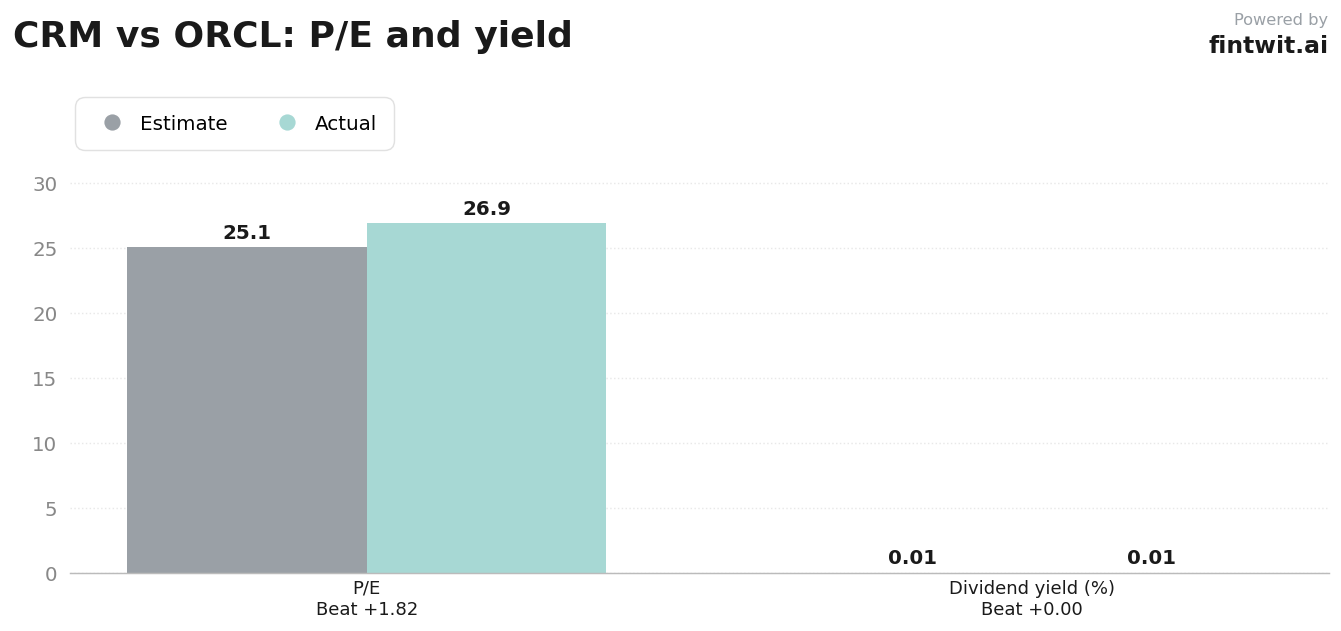
- CRM P/E Ratio: 25.05
- ORCL P/E Ratio: 26.87
- CRM Revenue Growth: 13% Y/Y (Q1 FY27)
- ORCL Revenue Growth: 21% Y/Y (Q4 FY26)
- CRM Dividend Yield: 0.85%
- ORCL Dividend Yield: 1.29%
- CRM 1-Year Price Change: -38.05%
- ORCL 1-Year Price Change: -39.62%
Bull and bear on each
The bull case for Salesforce rests on the successful monetization of Agentic Work Units. Conversely, the bear case highlights the risk of seat-based subscription cannibalization.
Oracle bulls point to the massive OCI backlog as evidence of AI dominance. Bears remain concerned about the balance sheet impact of debt-funded data center expansion.
- CRM Bull: Successful pivot to Agentic Enterprise driving organic growth
- CRM Bull: $50B share repurchase program provides EPS support
- CRM Bear: Execution risk in monetizing new AI-driven product metrics
- CRM Bear: Slowing growth in core CRM business as platform matures
- ORCL Bull: Explosive growth in OCI and AI infrastructure demand
- ORCL Bull: Competitive advantage in high-performance AI training via RDMA
- ORCL Bear: Extremely capital-intensive model leading to negative free cash flow
- ORCL Bear: High customer concentration and potential for contract non-fulfillment
The verdict
Salesforce offers a more balanced profile of high-margin software growth and aggressive capital returns. The company's ability to scale AI agents without proportional headcount increases provides a clear path to margin expansion.
Oracle remains a high-beta play on AI infrastructure. Its success depends entirely on whether the $638 billion backlog converts to high-margin revenue before the capital expenditure cycle drains free cash flow.