The Top Dividend Yields Right Now: Who Is Safe and Who Is a Trap
High yields often signal distress. We evaluate current market leaders in dividend payouts to separate sustainable income from potential capital traps.

Why these yields right now
Market volatility and shifting interest rate expectations have pushed dividend yields for several major firms into the 9% to 10% range. Investors are currently pricing in higher risk premiums for companies in the telecom and asset management sectors.
A high yield is not inherently a sign of a failing business model. However, it often reflects a market-wide repricing of risk that forces income-focused investors to distinguish between structural dividend growth and temporary yield spikes caused by share price depreciation.
The top yielders
The following companies represent the current upper echelon of dividend yields. Investors should evaluate these based on their ability to maintain cash flow coverage rather than raw yield percentages alone.
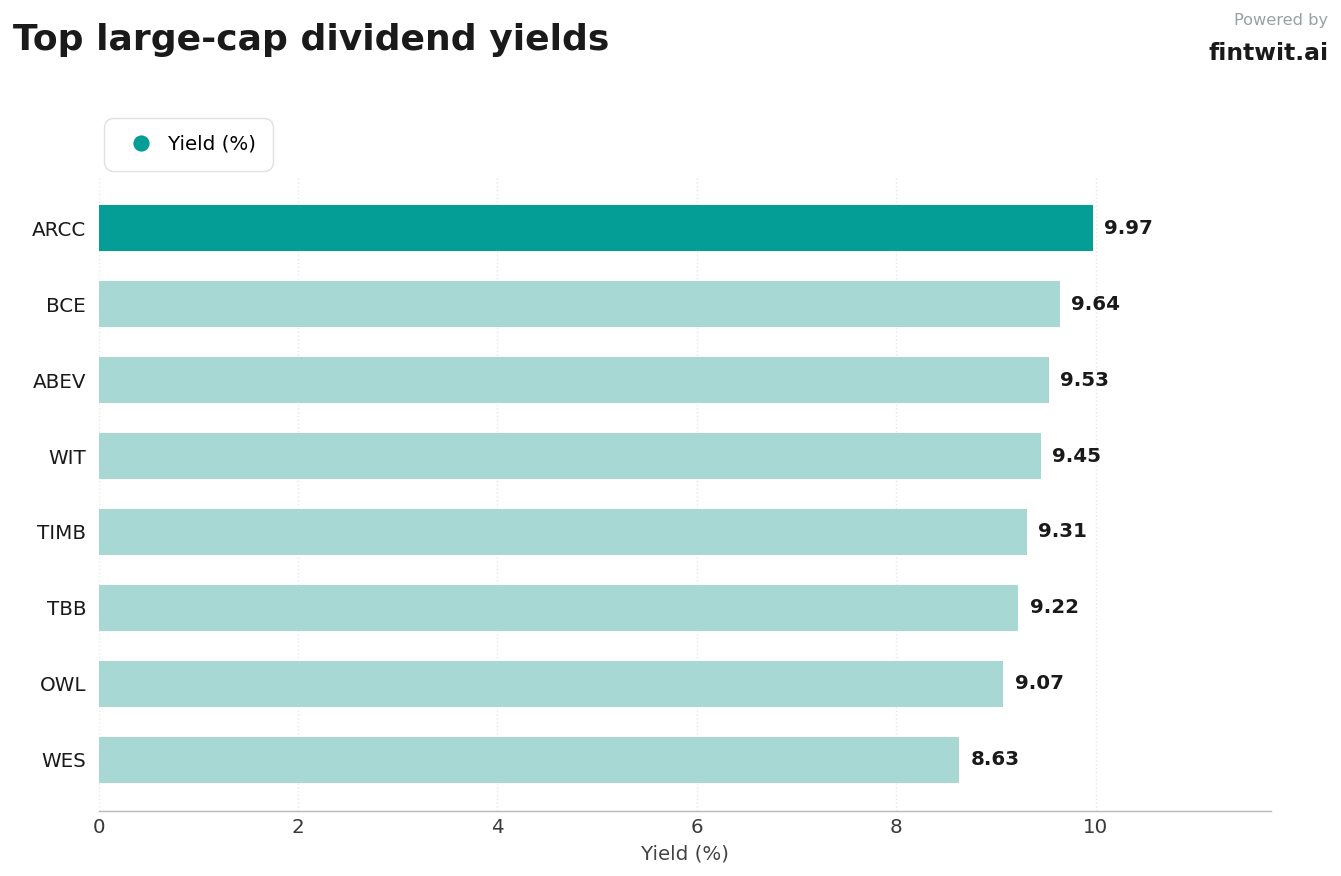
The chart below illustrates the yield distribution across these specific tickers, highlighting the divergence between stable income generators and those with volatile payout histories.
- Ares Capital (ARCC): 9.97% yield, 87% payout ratio, moderate safety rating.
- BCE Inc (BCE): 9.64% yield, 40-55% payout ratio, improved safety rating.
- Ambev SA (ABEV): 9.53% yield, 62-73% payout ratio, moderate safety rating.
- Wipro Limited (WIT): 9.45% yield, 87% payout ratio, moderate safety rating.
- TIM Participacoes (TIMB): 9.31% yield, variable payout ratio, low safety rating.
- AT&T Inc (T): 9.22% yield, 54% payout ratio, high safety rating.
- Blue Owl Capital (OWL): 9.07% yield, 100% payout ratio, moderate safety rating.
- Western Midstream (WES): 8.63% yield, 120% payout ratio, moderate safety rating.
Yield traps
A yield trap occurs when a stock's high dividend is offset by a declining share price or an unsustainable payout ratio. Investors often fall for the headline yield while ignoring the underlying erosion of capital.
The following tickers exhibit specific risk flags that suggest their current yields may not be sustainable over the long term.
- TIM Participacoes (TIMB): Highly dependent on unpredictable special distributions rather than fixed policy.
- Blue Owl Capital (OWL): Thin earnings coverage and significant exposure to floating-rate debt.
- Western Midstream (WES): High payout ratio relative to earnings, sensitive to commodity price volatility.
- Ares Capital (ARCC): High sensitivity to interest rate fluctuations inherent in the BDC structure.
Build an income sleeve
Constructing a resilient income portfolio requires balancing high-yield assets with those possessing strong free cash flow coverage. AT&T (T) remains a cornerstone for many, given its 2.38x free cash flow coverage ratio.
Investors should prioritize companies that have reset their dividends to align with actual cash generation, such as BCE Inc following its 2025 adjustment. Diversification across sectors like energy midstream and consumer defensive can mitigate the impact of sector-specific downturns.