The Top Dividend Yields Right Now: Who Is Safe and Who Is a Trap
High yields often signal distress. We break down the top dividend payers to identify which are sustainable and which are potential traps for your portfolio.

Why these yields right now
Market volatility has pushed dividend yields to levels not seen in years, particularly in the telecommunications and financial services sectors. Investors are currently pricing in significant risk, leading to depressed share prices that mathematically inflate yield percentages.
A yield above 8% often serves as a market signal that the dividend may be at risk of a reduction. While some companies maintain these payouts through robust cash flow, others are paying out more than they earn, creating a structural deficit that is unsustainable over the long term.
The top yielders
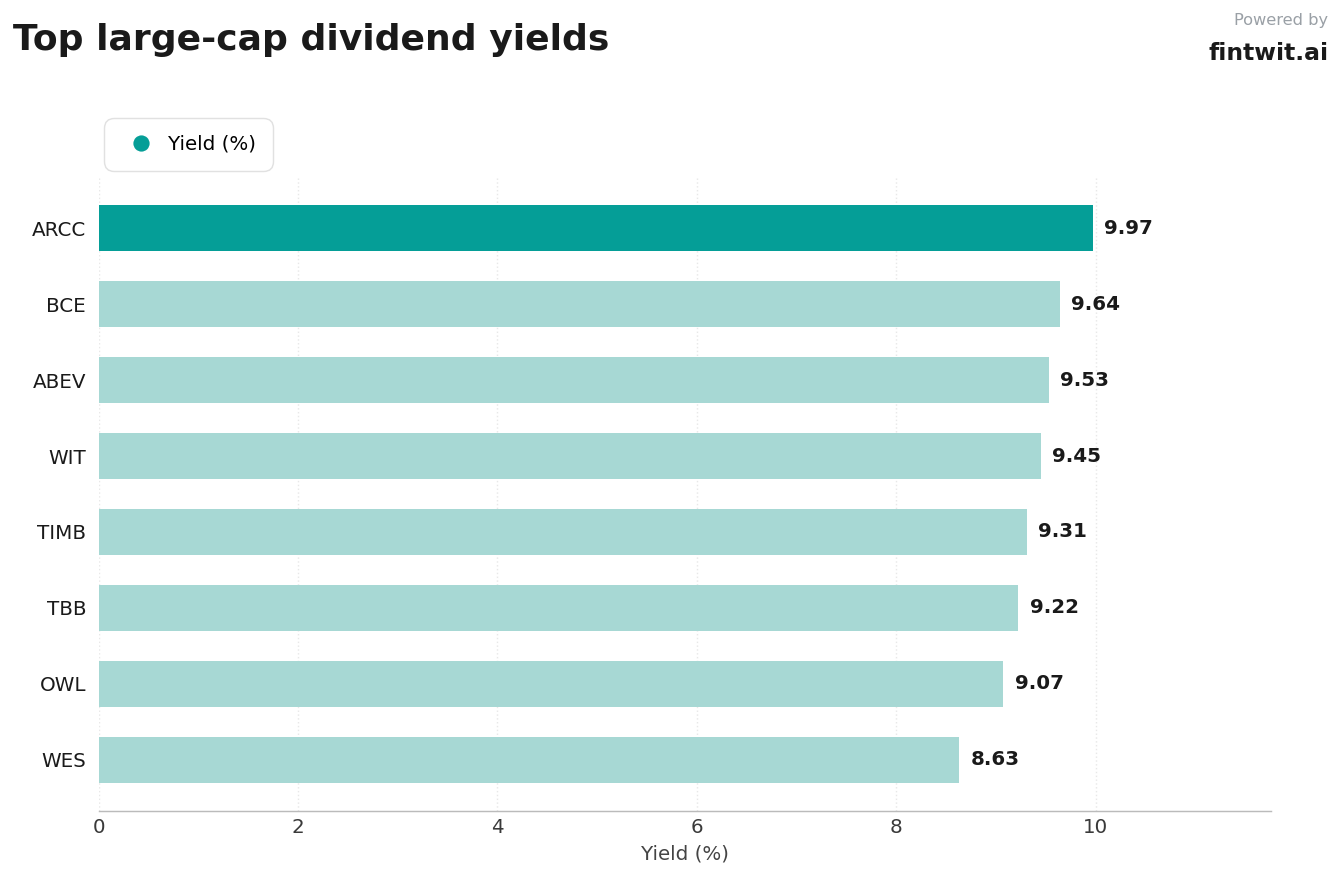
The following list highlights companies currently providing yields exceeding 8.5%. Investors must weigh these returns against the specific payout ratios and operational risks associated with each business model.
Data indicates that while some of these firms maintain stable cash flows, others rely on debt or capital recycling to fund distributions.
- Ares Capital (ARCC): 9.97% yield, 117.8% payout ratio, Low safety rating.
- BCE Inc (BCE): 9.64% yield, 25.81% payout ratio, Improved safety rating.
- Ambev SA (ABEV): 9.53% yield, 94% payout ratio, Moderate safety rating.
- Wipro Limited (WIT): 9.45% yield, 95.1% payout ratio, Low safety rating.
- TIM Participacoes (TIMB): 9.31% yield, 80.98% payout ratio, Moderate safety rating.
- AT&T Inc (T): 9.22% yield, 48.68% payout ratio, High safety rating.
- Blue Owl Capital (OWL): 9.07% yield, 118% payout ratio, Low safety rating.
- Western Midstream (WES): 8.63% yield, 120% payout ratio, Moderate safety rating.
Yield traps
A yield trap occurs when a stock's high dividend yield is the result of a falling share price rather than a growing business. These companies often face structural headwinds that threaten the long-term viability of their cash distributions.
Investors should prioritize companies with payout ratios below 80% and consistent free cash flow generation. When a payout ratio exceeds 100%, the company is effectively borrowing to pay its shareholders, which is a precursor to a dividend cut.
- ARCC: High payout ratio and BDC structure risks.
- BCE: Recent dividend cut and high debt levels.
- WIT: High payout ratio and declining operating margins.
- OWL: High payout ratio and sensitivity to interest rate cycles.
- WES: High payout ratio and concentration risk regarding OXY.
Build an income sleeve
Constructing a resilient income sleeve requires diversifying across sectors to mitigate industry-specific shocks. While AT&T (T) demonstrates high safety with a 48.68% payout ratio, it remains tethered to the high debt levels typical of the telecom sector.
Investors should monitor quarterly earnings reports to ensure that dividend coverage ratios remain within management's stated targets. Relying solely on yield without evaluating the underlying payout safety often leads to capital erosion that offsets any income gains.