Salesforce (CRM) vs Oracle (ORCL): Which Is the Better Buy in 2026?
Salesforce and Oracle are both betting big on AI. We break down the financials, analyst sentiment, and growth catalysts to see which stock wins.
The matchup
Salesforce and Oracle represent two distinct paths to AI monetization in the enterprise sector. Salesforce focuses on the application layer, leveraging its massive CRM footprint to deploy Agentforce and Data 360 workflows.
Oracle has pivoted into a full-stack cloud provider, betting its future on OCI infrastructure and massive data center expansion. The competition centers on whether enterprise budgets will favor infrastructure-heavy cloud providers or software-layer productivity tools.
- Salesforce (CRM) market cap: $183.07 billion.
- Oracle (ORCL) market cap: $430.49 billion.
- Salesforce focus: Enterprise CRM ecosystem and AI-driven workflow automation.
- Oracle focus: Full-stack cloud infrastructure (IaaS + SaaS) and massive data center scale.
Numbers side by side
Financial metrics reveal the divergence in growth strategies between the two software giants. Oracle is currently prioritizing scale, while Salesforce is optimizing for profitability and shareholder returns.
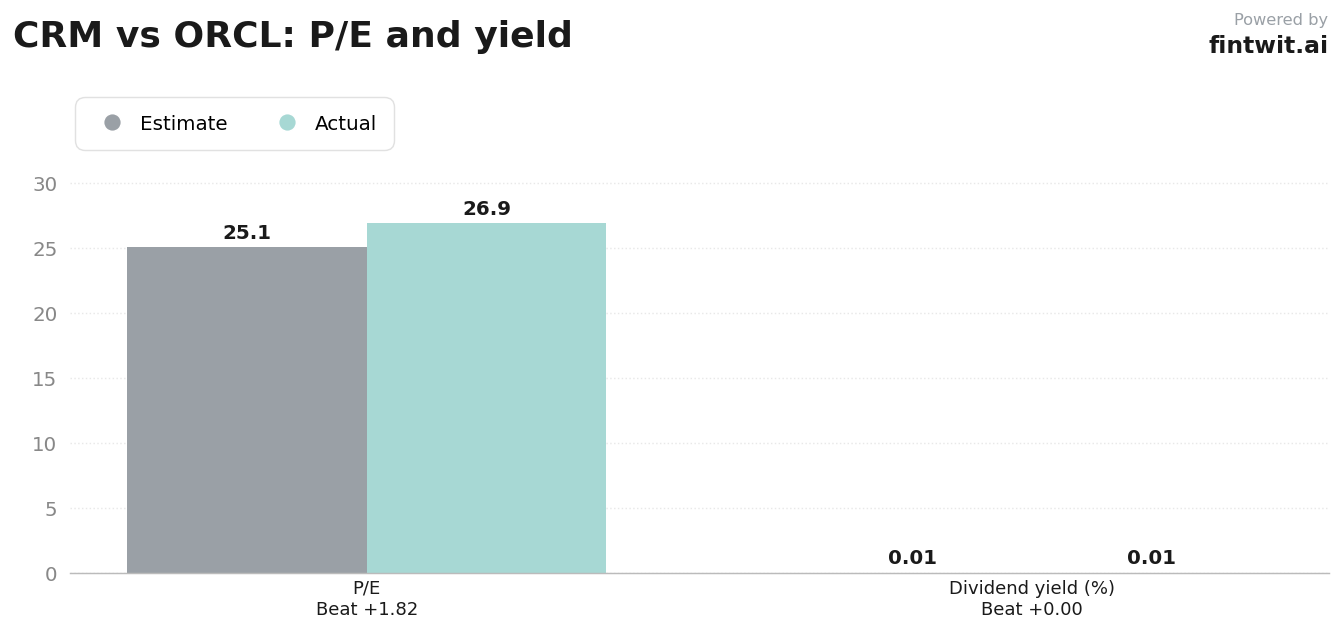
Refer to the valuation-side-by-side chart for a detailed breakdown of current multiples and performance trends.
- Salesforce P/E ratio: 25.05; Oracle P/E ratio: 26.87.
- Salesforce 1-year performance: -32.12%; Oracle 1-year performance: -52.01%.
- Salesforce revenue growth: 13% Y/Y (Q1 FY27); Oracle revenue growth: 21% Y/Y (Q4 FY26).
- Salesforce dividend yield: 0.85%; Oracle dividend yield: 1.29%.
- Salesforce operating margin: 34.8% (Non-GAAP); Oracle operating margin: ~32%.
Bull and bear on each
Both companies face significant execution risks as they scale their AI offerings. Salesforce must prove it can monetize Agentforce, while Oracle faces the challenge of managing its massive capital expenditure requirements.
- CRM Bull: Agentforce ARR has already surpassed the $1 billion milestone.
- CRM Bull: $25 billion share repurchase program signals management confidence.
- CRM Bear: Decelerating organic growth and potential budget rotation toward infrastructure.
- ORCL Bull: Massive $638 billion RPO backlog provides long-term revenue visibility.
- ORCL Bull: 93% IaaS growth demonstrates successful OCI competitive positioning.
- ORCL Bear: $70 billion FY27 CapEx plan creates significant balance sheet pressure.
The verdict
Determining the superior investment requires weighing Salesforce's mature SaaS profitability against Oracle's explosive infrastructure growth. Oracle's $638 billion backlog suggests a dominant position in the AI-driven cloud market, though it carries higher execution risk.
Salesforce remains a safer, more predictable play for investors who prefer established application-layer dominance. The final decision depends on your risk tolerance regarding infrastructure-heavy capital spending versus software-layer AI adoption.