Should You Buy AngloGold Ashanti (AU) After the 9.6% Selloff?
AngloGold Ashanti (AU) shares dropped 9.6% amid a sector-wide gold selloff. We analyze the fundamentals, analyst targets, and the path forward for investors.

What just happened
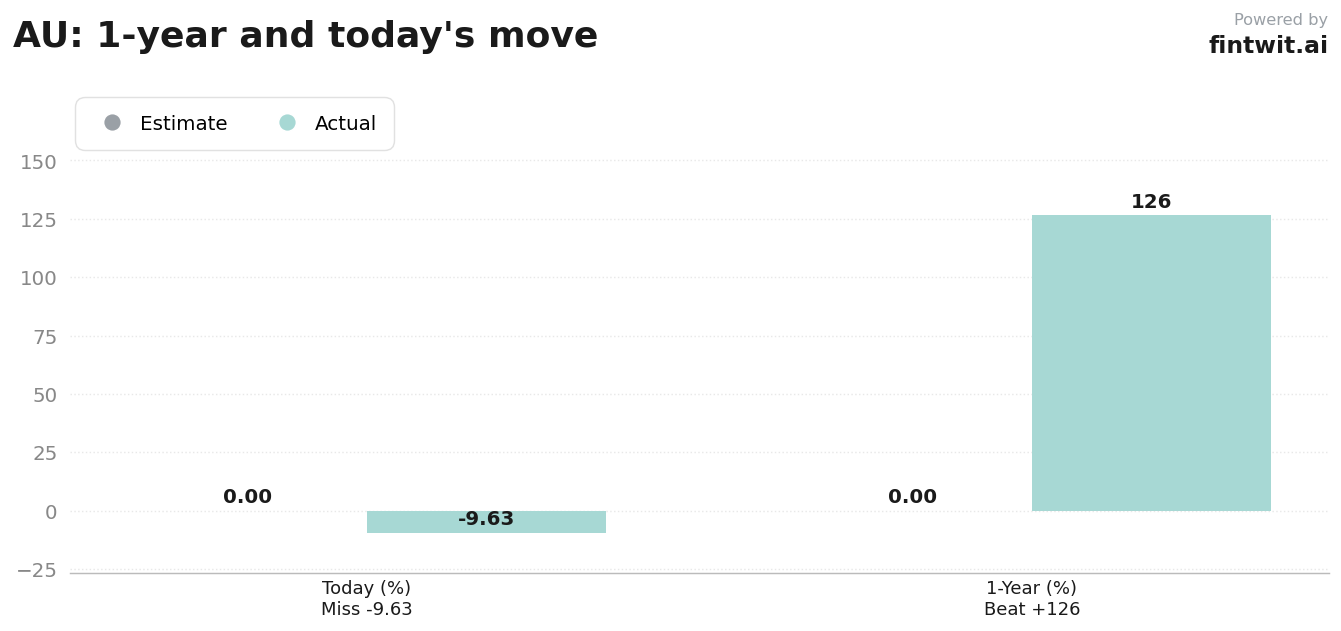
The sharp decline in AU shares reflects a cooling period for gold equities as investors recalibrate expectations against rising interest rates. Higher Treasury yields increase the opportunity cost of holding non-yielding assets, putting immediate pressure on gold producers.
Despite the daily volatility, the company remains in a strong position following its Q1 2026 earnings report. The market is currently digesting a combination of profit-taking and macroeconomic headwinds that have impacted the entire mining industry.
The following chart illustrates the 1-year price trajectory and the recent intraday move.
Bull case
- Q1 2026 headline earnings reached $2.52 per share, beating consensus estimates by 8.6%.
- The company generated record free cash flow of $1.2 billion during the first quarter.
- Revenue surged 63.7% year-over-year, demonstrating strong operational scale.
- Scotiabank analyst Tanya Jakusconek maintains a Buy rating with a $133.00 price target.
- Citigroup analyst Ephrem Ravi maintains a Strong Buy rating with a $120.00 price target.
- A newly approved $2.0 billion share repurchase program provides a floor for shareholder value.
Bear case
- Rising Treasury yields continue to dampen investor appetite for gold-linked equities.
- The company experienced a minor top-line revenue miss in the most recent quarter.
- Sector-wide selloffs often trigger technical selling that can decouple share prices from underlying fundamentals.
- Operational execution at the Obuasi mine remains a critical dependency for long-term production targets.
- Gold price volatility directly impacts the company's margins and valuation multiples.
Fintwit's AI verdict
The quantitative model evaluates AU based on a composite of cash flow generation, earnings momentum, and analyst sentiment. While the recent price action reflects broader market anxiety, the underlying financial health of the firm suggests a divergence between current valuation and historical performance.
Investors weighing the current entry point should consider the balance between macroeconomic risks and the company's internal growth initiatives. The following indicator provides the model's current stance on the asset.