Is The Allstate Corporation (ALL) Undervalued? A Valuation Analysis
Allstate (ALL) trades at a 5.4 P/E ratio, significantly below industry peers. We analyze the underwriting performance, growth strategy, and market valuation.

The headline number
Allstate currently trades at a price of $251.17, supported by a 1.96% dividend yield. The valuation is anchored by a P/E ratio of 5.4, which suggests the market is pricing in significant future earnings volatility or a cyclical peak.
Management's execution of the Transformative Growth plan has been the primary driver of recent performance. This strategy focuses on expanding personal lines market share while leveraging the ALLIE AI ecosystem to optimize operational costs.
- Raymond James maintains a Strong Buy rating with a $300.00 fair value target.
- HSBC holds a neutral view with a $264.00 fair value target.
- Morgan Stanley remains Equal-Weight with a $240.00 fair value target.
- The company reported an 82.0 combined ratio in Q1 2026, signaling improved underwriting efficiency.
Peer comparison
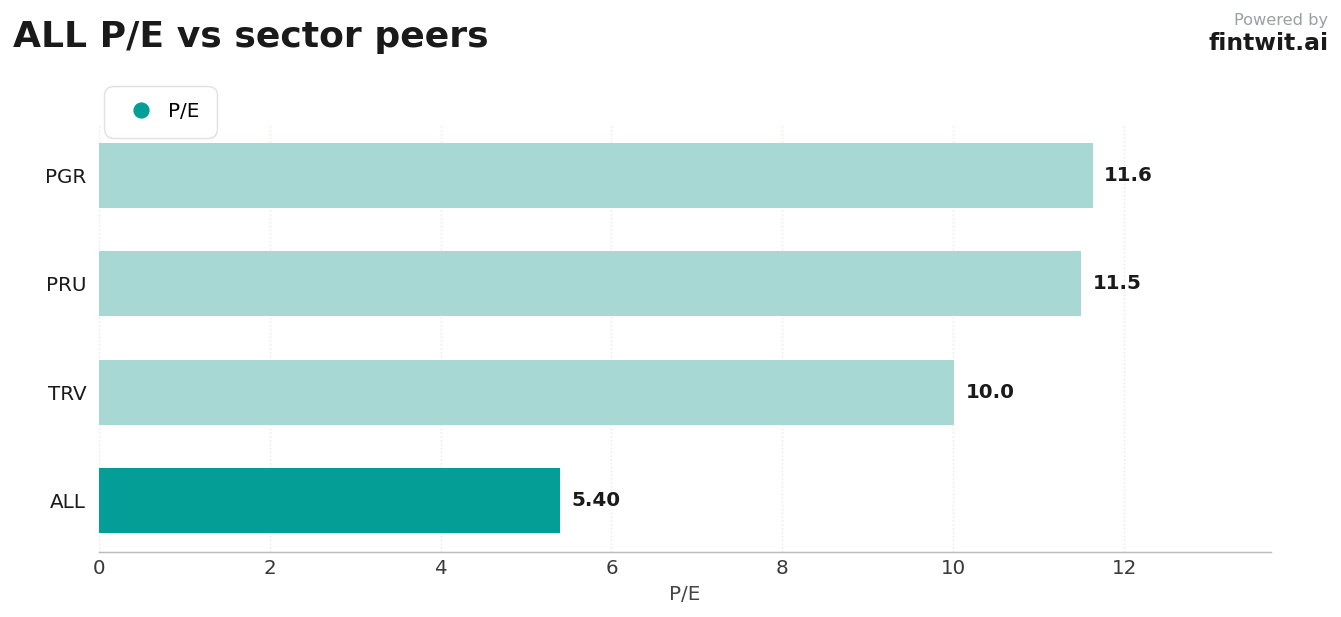
Allstate's valuation gap is stark when compared to other major players in the financial services and insurance sectors. The current 5.4 P/E ratio stands in contrast to competitors that command higher multiples due to perceived growth consistency or broader diversification.
Investors often look to these peers to determine if Allstate's discount is justified by its specific risk profile or if it represents a mispricing of the firm's recent operational improvements.
- Progressive (PGR) trades at an 11.63 P/E ratio, reflecting its leadership in personal lines.
- The Travelers Companies (TRV) trades at a 10.01 P/E ratio, highlighting the premium for diversified P&C peers.
- Prudential Financial (PRU) trades at an 11.5 P/E ratio, showing the gap between Allstate and broader financial firms.
Bull vs bear
The bull case for Allstate centers on the sustainability of its underwriting margins and the aggressive return of capital to shareholders. The company recently authorized a $4 billion share repurchase program alongside an 8% dividend increase.
Conversely, the bear case highlights the potential for a profit slowdown in the second half of 2026. Analysts are bracing for a potential double-digit profit dip in Q2 2026 as the company faces sector-wide pricing pressures.
- Bull: Successful AI integration via the ALLIE ecosystem reduces long-term operational expenses.
- Bull: Strong capital position supports consistent shareholder returns and dividend growth.
- Bear: Catastrophe-loss volatility remains a constant threat to underwriting margins.
- Bear: Regulatory and legal headwinds, including ongoing litigation, could impact financial reserves.
- Bear: Inflationary pressures on auto repair costs continue to challenge loss ratio targets.
Fintwit's AI verdict
The current valuation suggests that the market has not fully accounted for the structural improvements in the company's underwriting performance. While sector-wide headwinds persist, the firm's ability to maintain a disciplined capital deployment strategy provides a floor for the stock price.
Investors should monitor the upcoming quarterly earnings releases to confirm if the recent margin expansion is sustainable or if the company will face the anticipated profit compression.