EV Charging Market Outlook: Analyzing TSLA, CHPT, and the Infrastructure Play
EV charging is a critical pick-and-shovel play. We break down the sector's transition to profitability and the risks facing major operators.

The thesis
The investment thesis for EV charging is a classic pick-and-shovel play on the global transition to electric mobility. It is predicated on the necessity of a reliable, accessible charging network to support mass vehicle adoption.
As the vehicle-to-charger ratio remains a critical bottleneck in major markets, the buildout of fast-charging corridors and localized infrastructure has become a capital-intensive asset class. This transition is driven by climate mandates, government subsidies, and shifting consumer demand patterns.
Martin Linder of McKinsey & Company notes that downstream charging infrastructure across multiple vehicle classes must ramp up rapidly. He emphasizes that upstream and downstream infrastructure are interdependent and face significant bottlenecks regarding technology, capital, and commitment.
Why now
The industry is currently transitioning from a speculative land-grab phase to a more disciplined, operationally focused maturity. Market participants are shifting their focus from raw deployment numbers to sustainable profitability and high utilization rates.
2026 outlooks from firms like Strategy& emphasize the urgent need for improved reliability and interoperability. The sector must now navigate uneven adoption rates and evolving policy support to maintain investor confidence.
The IEA Global EV Outlook 2026 highlights that while long-term demand fundamentals remain strong, the industry faces pressure to prove its financial viability. Operators with poor unit economics are increasingly being punished by the market.
Stocks we're watching
The following companies represent the primary archetypes within the EV charging ecosystem, ranging from vertically integrated leaders to specialized network providers.
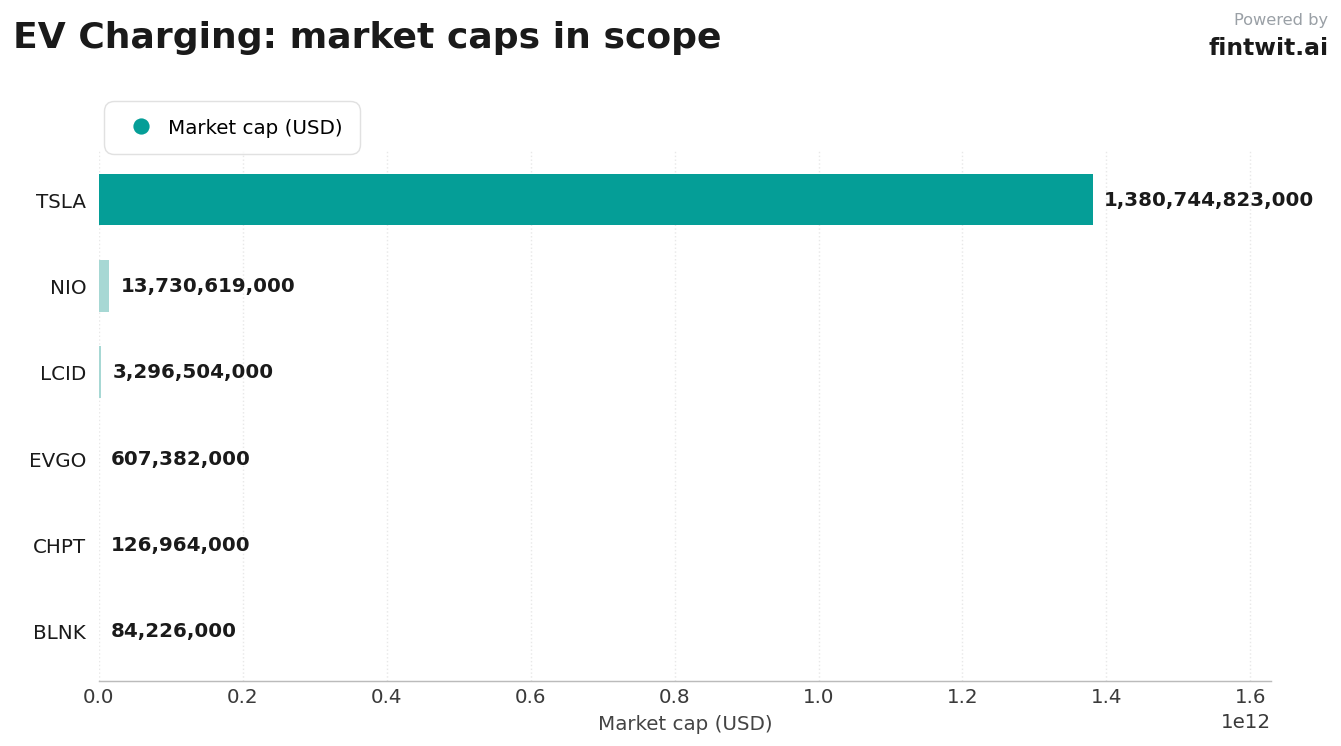
Market capitalization data reflects the current valuation disparity between established automotive leaders and pure-play charging infrastructure firms.
- TSLA (Tesla Inc): Ecosystem leader leveraging its dominant Supercharger network and vertical integration to set industry standards.
- CHPT (ChargePoint Holdings Inc): Network provider operating an asset-light model focused on selling hardware and software to commercial site hosts.
- BLNK (Blink Charging Co): Owner-operator utilizing a hybrid model of equipment sales and network ownership across residential and commercial segments.
- EVGO (Evgo Inc): Fast-charging specialist focused on high-utilization DC fast-charging infrastructure in urban and highway corridors.
- LCID (Lucid Group Inc): OEM participant integrating proprietary charging technology into its luxury EV platform to enhance the premium ownership experience.
- NIO (Nio Inc Class A ADR): Innovation pioneer differentiating through a unique battery-swapping infrastructure model that addresses charging time friction.
Risks that break it
Investors must account for the high capital intensity and long lead times associated with grid interconnection, permitting, and site development. These factors can significantly compress margins for operators.
The sector remains sensitive to shifts in government funding, such as potential NEVI program delays or budget cuts, which directly impact the pace of deployment.
Market maturation is forcing a shift in focus toward sustainable profitability, which creates volatility for companies unable to demonstrate strong unit economics.
- Uncertainty in government funding programs impacting the pace of infrastructure deployment.
- High capital intensity and long lead times for grid interconnection and site permitting.
- Market maturation punishing operators with low utilization rates and poor unit economics.