Delta Air Lines Inc (DAL) Q2 Earnings Preview: What to Watch
Delta Air Lines reports Q2 2026 earnings on July 9. Analysts focus on premium cabin demand, fuel costs, and margin sustainability.

The setup
Wall Street is monitoring a widening scissors effect where rising fuel and labor costs threaten to outpace top-line gains. Management previously provided guidance for low-teens revenue growth in Q2 with operating margins between 6% and 8%.
Investors are looking for confirmation that these margin targets remain achievable. Any deviation from the guidance range could signal broader weakness in the airline sector's pricing power.
- UBS analyst Atul Maheswari noted that buy-side expectations are currently leaning toward the lower end of the company's guidance range.
- TD Cowen analyst Thomas Fitzgerald maintains a $106 price target, contingent on industry-wide price increases holding steady.
- Goldman Sachs analyst Catherine O'Brien holds a $116 target, citing strong revenue trends and lower fuel prices as potential tailwinds.
Consensus numbers
The market consensus for the second quarter sits at $1.49 EPS on $17.47 billion in revenue. These figures reflect significant volatility in analyst sentiment over the last 90 days.
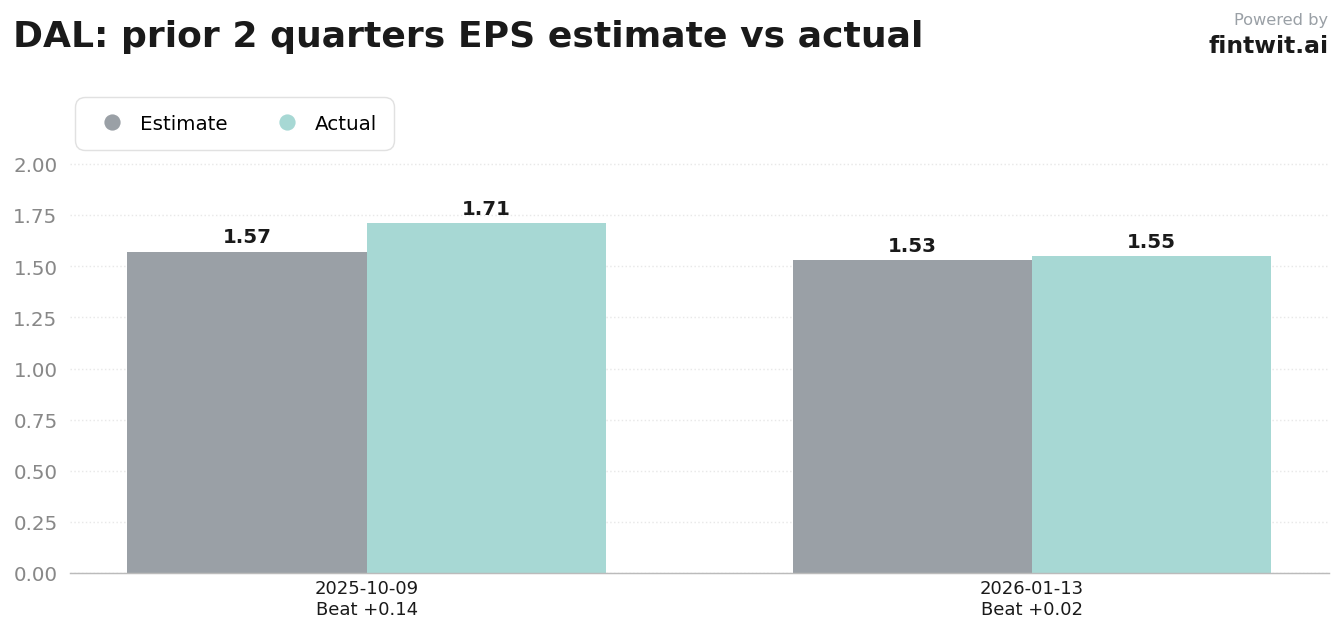
Historical performance shows Delta has frequently outperformed conservative estimates, as seen in the October 2025 and January 2026 reporting periods.
- Consensus EPS Estimate: $1.49
- Consensus Revenue Estimate: $17.47 billion
- Q4 2025 Actual EPS: $1.71 vs $1.57 estimate
- Q1 2026 Actual EPS: $1.55 vs $1.53 estimate
- Beat Probability: 65%
- Miss Probability: 25%
- Inline Probability: 10%
What we'll watch on the call
Management's commentary on capacity discipline will be the primary driver for stock volatility post-earnings. Analysts are specifically looking for evidence that the company can maintain unit revenue (RASM) growth through the remainder of the year.
The performance of the internal refinery remains a critical hedge against energy market volatility. Investors will scrutinize how this asset offsets regional geopolitical risks affecting jet fuel prices.
- Premium Cabin Revenue: Monitoring for signs of softening demand in Comfort+, Business, and First Class segments.
- Corporate Travel: Seeking confirmation that the double-digit growth observed in previous quarters persists into the fall.
- Refinery Operations: Assessing the impact of the internal refinery on mitigating fuel price volatility.
- Geopolitical Impact: Evaluating how Middle East tensions are influencing fuel price expectations for the second half of 2026.
- Pricing Power: Determining if post-Labor Day pricing power is holding up against industry-wide capacity increases.
Fintwit's AI verdict
The quantitative model suggests that the current market valuation does not fully account for the resilience of the premium travel segment. While cost pressures are real, the company's ability to maintain unit revenue growth provides a buffer that many analysts may be underestimating.
Investors should look closely at the margin guidance provided during the call, as this will likely dictate the next major move in the share price. The data points toward a favorable setup for those looking at the long-term trajectory of the carrier.