The Cheapest Large Caps Right Now: A P/E Screen of CHTR, ALL, and More
A deep dive into ten large-cap stocks with low P/E ratios, separating market overreactions from legitimate fundamental risks.

How we screened
We filtered the current market for large-cap equities with P/E ratios below 8.0x to identify potential value opportunities. This screen focuses on companies where market sentiment has diverged significantly from historical earnings power.
The resulting list includes firms across communication services, financial services, and basic materials. We categorized each discount as either earned, where fundamental business metrics have deteriorated, or unearned, where market sentiment likely overreacted to transient factors.
The list
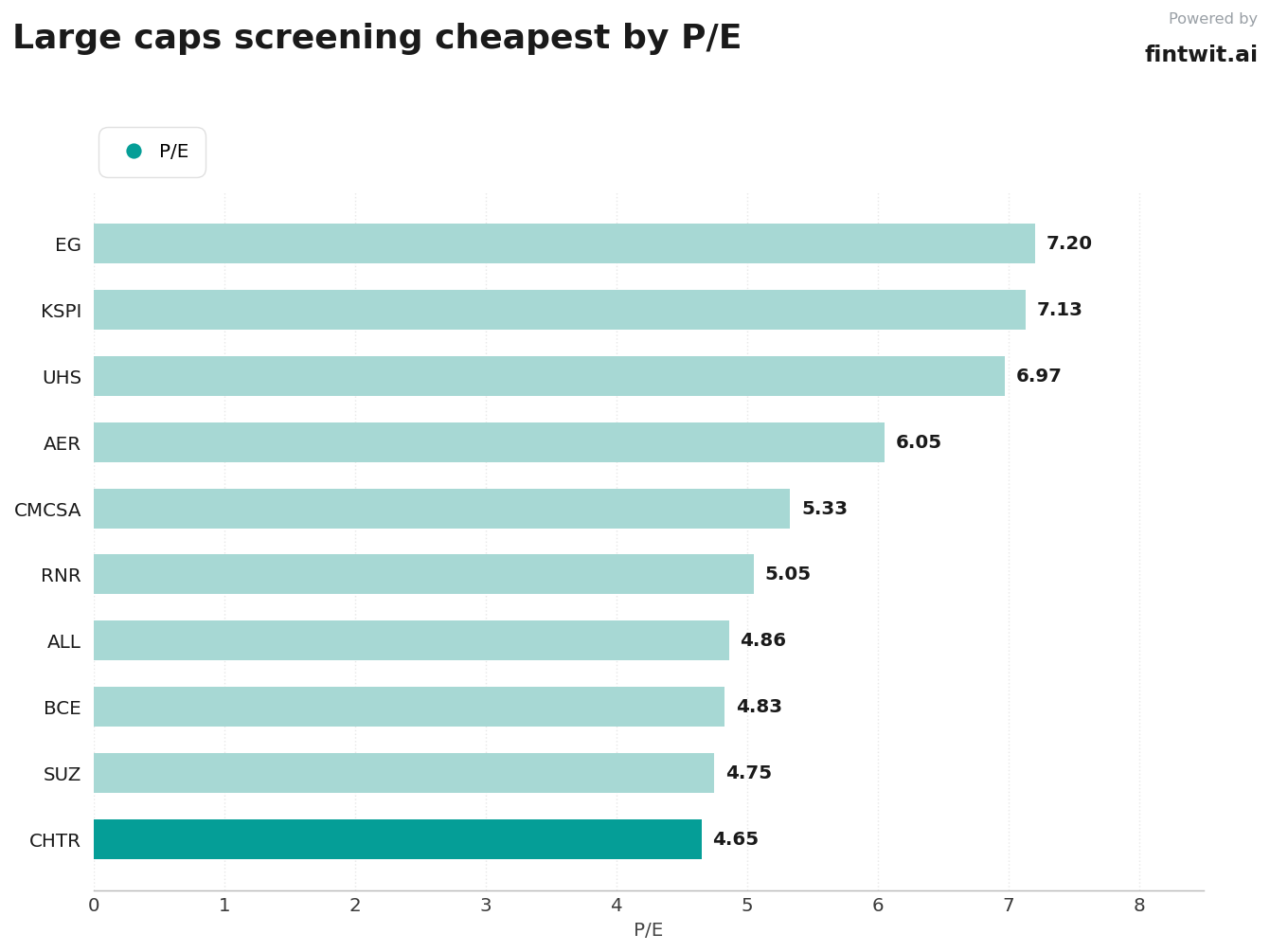
The following companies represent the lowest P/E multiples currently available in the large-cap space. Investors should note that low multiples often signal significant underlying business risks.
- CHTR: P/E 4.65. Earned discount due to subscriber erosion and high debt. Analyst quote: CHTR stock declined approximately -17% over the last 30 days, driven by a Q1 earnings miss.
- SUZ: P/E 4.75. Earned discount from pulp market headwinds. Analyst quote: Suzano S.A. is progressing with deleveraging, but at a slower pace than ideal due to excess CapEx.
- BCE: P/E 4.83. Earned discount from 3.8x leverage. Analyst quote: BCE is facing a challenging future due to its high leverage ratio and low growth environment.
- ALL: P/E 4.86. Unearned discount despite strong underwriting. Analyst quote: The rebound came despite lingering pressure from KBW analyst Meyer Shields' June 8 downgrade.
- RNR: P/E 5.05. Unearned discount in reinsurance. Analyst quote: Citi analyst Matthew Heimermann argued that the company offers an attractive setup regardless of catastrophe losses.
- CMCSA: P/E 5.33. Earned discount from broadband overhang. Analyst quote: The problem is that the broadband overhang is too large to ignore.
- AER: P/E 6.05. Unearned discount due to sector rotation. Analyst quote: Recent pressures stem from investor sentiment, not from fundamental weakness at AER.
- UHS: P/E 6.97. Unearned discount from utilization trends. Analyst quote: The trend of increased health utilization following the early COVID years appears to have reversed.
- KSPI: P/E 7.13. Earned discount from regional risk. Analyst quote: The real question is whether you are underwriting a decade-long compounder or walking into a structurally misunderstood risk.
- EG: P/E 7.20. Unearned discount from cyclical fears. Analyst quote: Some analysts have pointed to the company's conservative reserving practices as potential positives.
Caveats
Investors must distinguish between a value trap and a genuine bargain. A low P/E ratio is not a guarantee of future performance, especially when the underlying business model is facing structural decline.
- High leverage ratios, such as the 3.8x seen at BCE, can quickly erode equity value if interest rates remain elevated.
- Subscriber churn in the telecom sector, specifically for CHTR and CMCSA, represents a permanent shift in revenue potential rather than a cyclical dip.
- Regulatory and geopolitical risks in emerging markets, as seen with KSPI, often justify a permanent discount to domestic peers.
- Sector rotation, while a headwind for AER, can reverse quickly when institutional capital flows shift back toward industrial assets.
How to use this screen
Use these metrics as a starting point for fundamental analysis rather than a buy signal. Focus on the free cash flow yield, which provides a clearer picture of actual cash generation than the P/E ratio alone.
For instance, RNR maintains a free cash flow yield of 33.35%, suggesting that the market's low valuation may be ignoring significant cash-generating capacity. Conversely, avoid companies where negative free cash flow, like KSPI's -8816.95%, indicates a reliance on external capital to fund operations.