The Cheapest Large Caps Right Now: A P/E Screen of 10 Stocks
A deep dive into 10 large-cap stocks with low P/E ratios, separating genuine value opportunities from fundamental traps.

How we screened
We filtered for large-cap equities with market capitalizations exceeding $10 billion and P/E ratios below 8.0x. This screen identifies companies currently facing significant market skepticism.
The objective is to distinguish between 'earned' discounts, where fundamental risks justify the low multiple, and 'unearned' discounts, where market sentiment has decoupled from actual cash flow generation.
The list
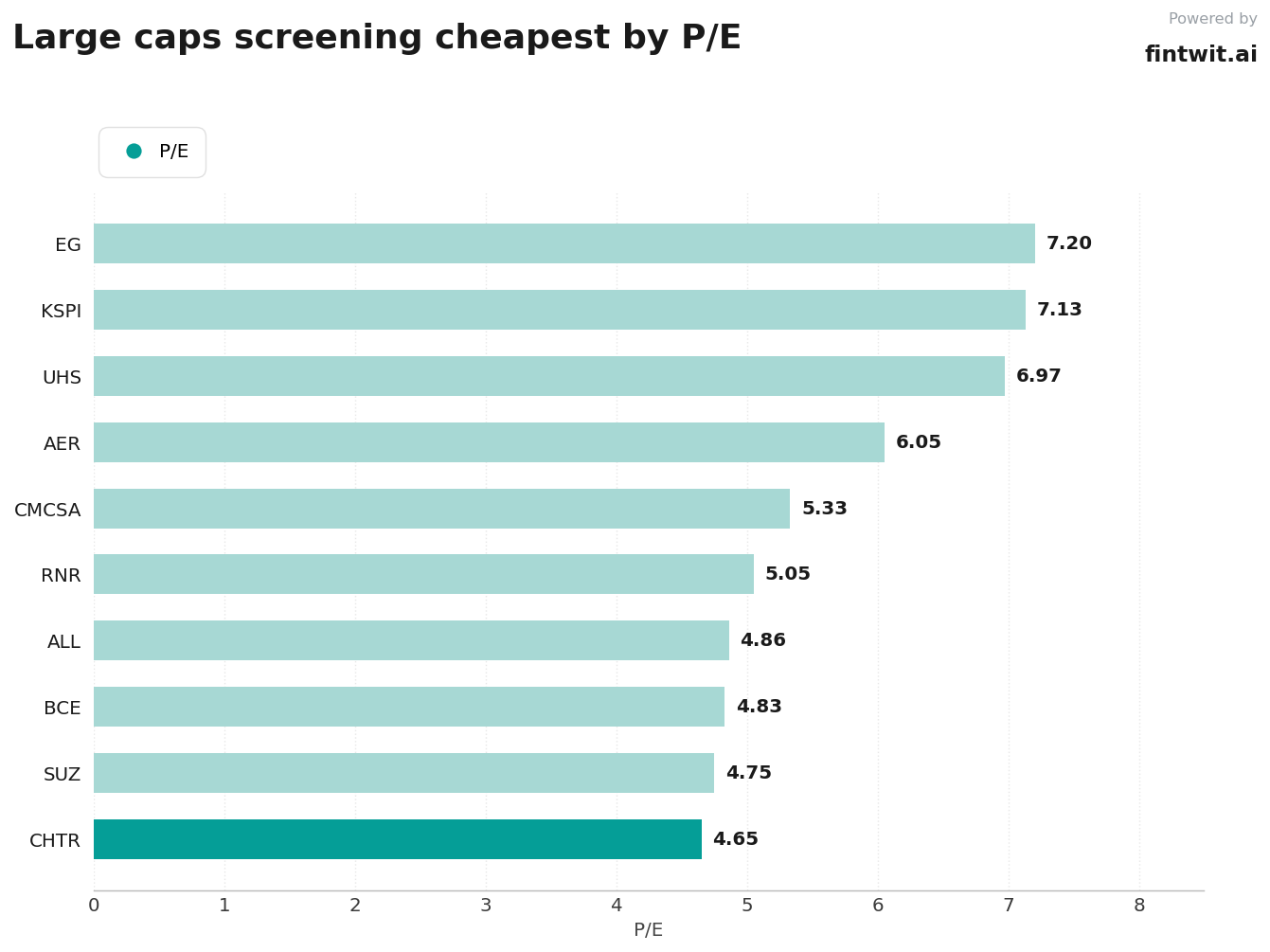
The following companies represent the lowest P/E multiples in our current dataset, ranging from 4.65x to 7.20x.
Investors should note that low multiples often correlate with sector-specific headwinds or governance concerns.
- CHTR: 4.65x P/E. Fundamental headwinds like subscriber loss are real, though the valuation discount may be excessive.
- SUZ: 4.75x P/E. The discount appears driven by cyclical commodity sentiment rather than structural deterioration.
- BCE: 4.83x P/E. Fundamental challenges in the Canadian telecom market justify a cautious valuation.
- ALL: 4.86x P/E. The discount is largely sentiment-driven, as improved underwriting results suggest a stronger fundamental picture.
- RNR: 5.05x P/E. The discount reflects sector-wide risk aversion rather than company-specific fundamental failure.
- CMCSA: 5.33x P/E. The market is likely over-penalizing the company for secular media and broadband trends.
- AER: 6.05x P/E. The discount is driven by a misperception of the aircraft leasing business model as a cash incinerator.
- UHS: 6.97x P/E. The discount appears to be a result of broad healthcare sector sentiment rather than specific fundamental decay.
- KSPI: 7.13x P/E. The discount is earned due to significant geopolitical and regulatory risks inherent in the market.
- EG: 7.20x P/E. The discount reflects legitimate concerns regarding financial performance and social inflation risks.
Caveats
Low P/E ratios are not a guarantee of future performance and can often serve as value traps.
Investors must account for debt levels, regulatory environments, and cyclicality before initiating positions.
- High free cash flow yields, such as the 36.06% seen at SUZ, can be misleading if capital expenditure cycles shift.
- Governance and regulatory risks, as seen in KSPI, can permanently impair shareholder value regardless of the P/E multiple.
- Sector-wide compression, such as the current trend in telecom, often persists longer than historical averages suggest.
- Earnings volatility in insurance, specifically for RNR and EG, can lead to sudden multiple expansion if catastrophe losses spike.
How to use this screen
Use this list as a starting point for fundamental analysis rather than a buy list. Compare these multiples against historical averages to identify outliers.
Focus on the 'earned' versus 'unearned' distinction to filter out companies facing structural decay. Prioritize firms with stable free cash flow conversion over those with high, but volatile, earnings.