The Boeing Company (BA) vs Lockheed Martin (LMT): Which Is the Better Buy in 2026?
Boeing and Lockheed Martin represent two distinct paths in aerospace. We break down the financials and risks to determine the better buy.
The matchup
Boeing operates as a global commercial aerospace duopoly, currently focused on stabilizing its 737 MAX and 787 production lines. The company carries a $695 billion backlog that provides long-term revenue visibility, though operational execution remains the primary hurdle.
Lockheed Martin functions as the primary contractor for the F-35 program, anchoring its business in U.S. and allied defense budgets. Its strategy centers on 21st Century Security and software-defined defense, providing a more stable, annuity-like revenue stream compared to commercial aviation.
- Boeing market cap: $172.93 billion.
- Lockheed Martin market cap: $145.19 billion.
- Boeing primary risk: Production delays and quality control.
- Lockheed Martin primary risk: High reliance on U.S. government spending at 93% of revenue.
Numbers side by side
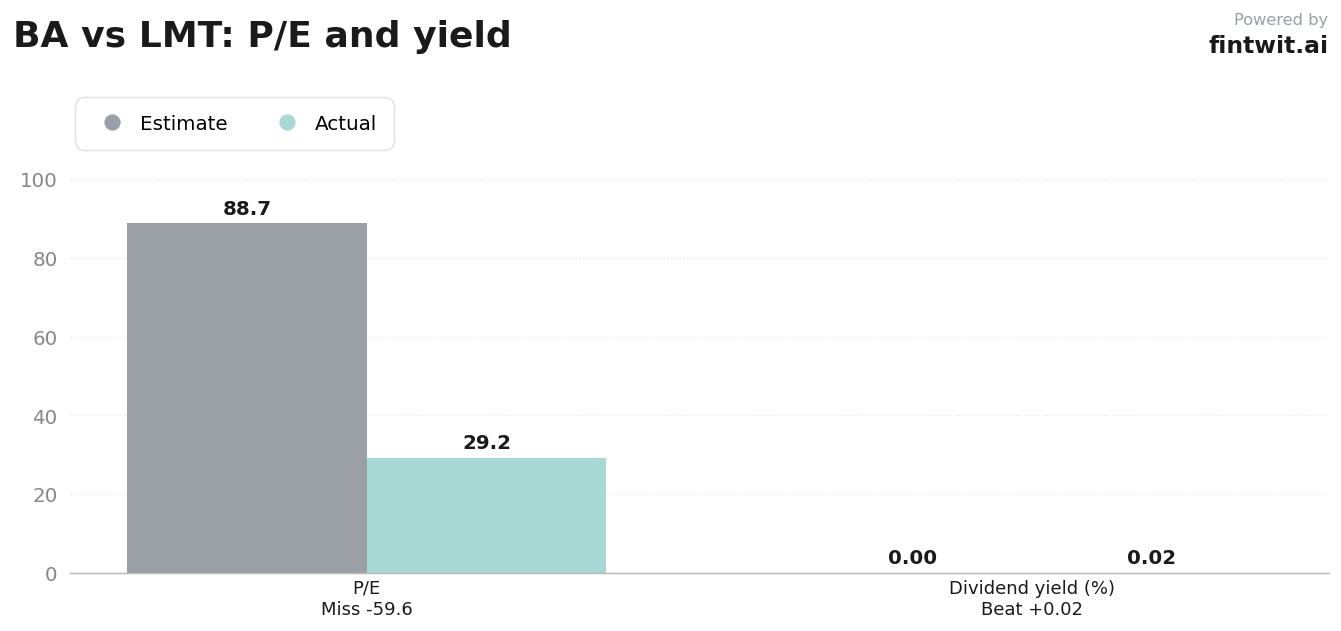
Financial metrics highlight the divergence between the two firms. Boeing is currently trading at a high P/E ratio of 88.73, reflecting the market's expectation of a significant earnings recovery as margins improve from their current 2% level.
Lockheed Martin maintains a more conservative P/E of 29.16, with a dividend yield of 2.09% that appeals to income-focused investors. Its operating margin of 11% remains superior to Boeing's, despite recent compression from program-specific charges.
- Boeing P/E Ratio: 88.73.
- Lockheed Martin P/E Ratio: 29.16.
- Boeing Revenue Growth (Q1 2026): 14% YoY.
- Lockheed Martin Revenue Growth (Q1 2026): 0% YoY.
- Boeing 1-Year Return: 3.18%.
- Lockheed Martin 1-Year Return: 9.34%.
Bull and bear on each
The bull case for Boeing rests on the successful ramp-up of its core aircraft programs and the potential for a massive valuation re-rating as cash flow inflects. Conversely, the bear case highlights the $46.9 billion debt load and the risk of further shareholder dilution.
Lockheed Martin bulls point to the strong demand for munitions and missile defense systems as a key growth driver. Bears emphasize that program-specific charges in the F-16 and C-130 lines are currently weighing on near-term profitability.
- Boeing Bull: Successful 777X certification and delivery.
- Boeing Bear: Persistent production delays and quality control issues.
- Lockheed Bull: Stable, long-term annuity from F-35 sustainment.
- Lockheed Bear: High political and budgetary risk due to government spending reliance.
- Bernstein (Douglas Harned) on Boeing: Outperform, $298 target.
- Susquehanna on Lockheed: Bullish, $700 target.
The verdict
Choosing between these two depends on an investor's tolerance for turnaround execution risk versus the stability of defense-sector annuities. Boeing offers high-beta exposure to a potential industrial recovery, while Lockheed Martin provides a defensive hedge with consistent dividend payouts.
The financial data suggests that while Boeing has more upside potential if it solves its production bottlenecks, Lockheed Martin currently presents a more predictable path for capital preservation and steady growth.