AstraZeneca PLC (AZN) Q2 2026 Earnings Preview: What to Watch
AstraZeneca (AZN) reports Q2 2026 earnings on July 27. Analysts expect $2.50 EPS. We analyze the $80 billion 2030 goal and oncology pipeline performance.

The setup
AstraZeneca maintains a full-year 2026 outlook calling for mid-to-high single-digit revenue growth and low double-digit Core EPS growth at constant exchange rates. Management continues to prioritize its oncology pipeline and strategic licensing to offset looming loss of exclusivity headwinds.
Market sentiment remains split between long-term growth potential and near-term clinical volatility. Analysts at Goldman Sachs maintain a Buy rating with a $97.00 price target, citing confidence in the company's strategic positioning.
- RBC Capital Markets analyst Shagun Singh maintains a positive outlook on the 2026 trajectory.
- Guggenheim analysts recently lowered their 2030 revenue estimate to $78 billion following the Wainua clinical setback.
- The company is navigating complex pricing pressures from Most Favored Nation provisions in global markets.
Consensus numbers
Wall Street expects AstraZeneca to deliver solid top-line performance despite macroeconomic headwinds in emerging markets. The focus remains on whether the company can maintain its margin profile while scaling its weight management and oncology portfolios.
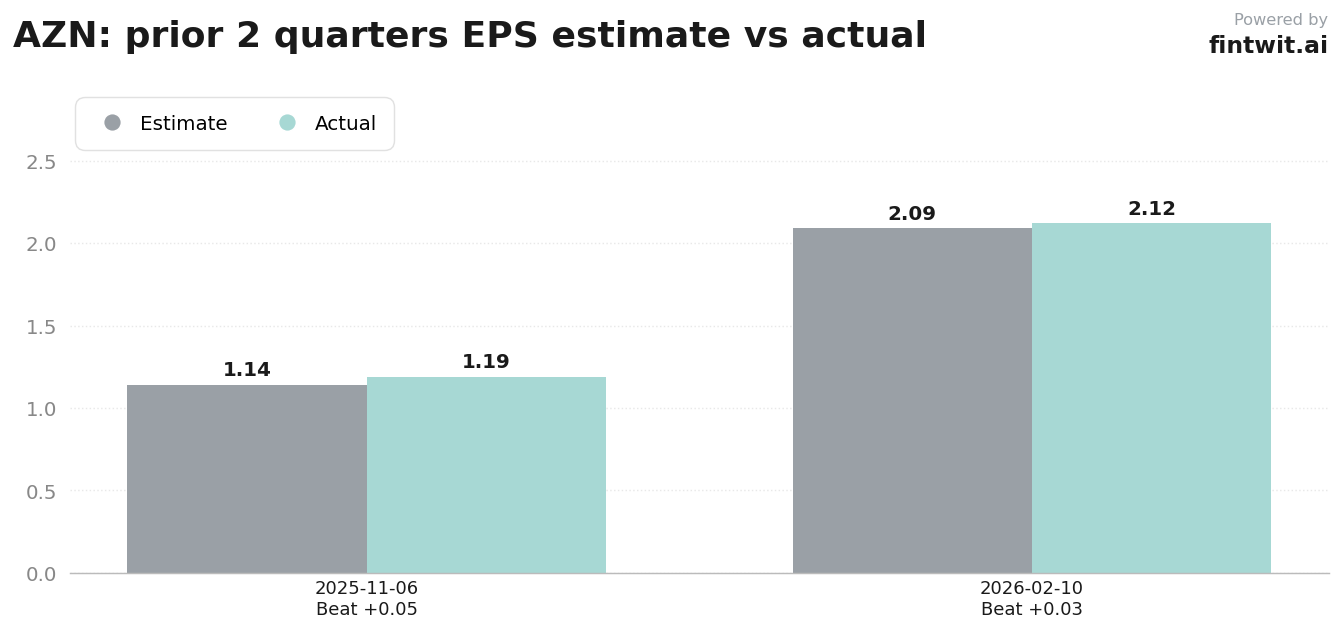
Historical performance shows a tendency for the company to outperform EPS estimates, as seen in the last two quarters.
- Q2 2026 EPS Estimate: $2.50.
- Q2 2026 Revenue Estimate: $15.45 billion.
- Beat Probability: 60% beat, 25% miss, 15% inline.
- Q1 2026 Actual EPS: $2.12 vs $2.09 estimate.
- Q4 2025 Actual EPS: $1.19 vs $1.14 estimate.
What we'll watch on the call
Investors are looking for clarity on how the company plans to bridge the gap toward its $80 billion 2030 revenue target. The integration of the CSPC weight management portfolio is a primary focus for analysts assessing near-term margin expansion.
Pricing pressures in China, specifically regarding the Volume-Based Procurement (VBP) program, remain a significant risk factor for the Biopharmaceuticals segment.
- Performance of the Oncology segment, specifically the contribution of the $600 million Zegfrovy licensing deal.
- Updates on the organic growth path toward the $80 billion 2030 revenue goal.
- Management commentary on the impact of MFN pricing provisions on future drug launches.
- Margin stability within the Biopharmaceuticals segment amid pricing changes in emerging markets.
- Integration progress and revenue contribution from the newly acquired CSPC weight management assets.
Fintwit's AI verdict
The quantitative model suggests that AstraZeneca's current valuation does not fully account for the long-term potential of its oncology pipeline. While clinical setbacks have introduced volatility, the underlying commercial momentum appears resilient enough to support a favorable outlook.
Investors should monitor the upcoming earnings call for evidence of disciplined capital allocation and R&D efficiency. The current risk-reward profile suggests that the market may be underestimating the company's ability to navigate near-term pricing headwinds.