Visa (V) vs. Mastercard (MA): Which Payment Giant is the Better Buy?
Visa (V) and Mastercard (MA) dominate the credit services industry. This analysis breaks down their financials, competitive advantages, and future outlook.
The matchup
Visa and Mastercard operate as duopolies in the global payments network, facilitating transactions between consumers, merchants, and financial institutions. Both companies benefit from an asset-light model, avoiding direct credit risk by not lending money themselves. Their revenue primarily derives from transaction processing fees and value-added services.
Visa's economic moat is built on strong brand recognition, extensive network effects, and high switching costs for users. Its payment network is the largest globally, making it challenging for new entrants to compete effectively. Mastercard shares similar competitive advantages, leveraging its brand and network to maintain its market position.
The companies' business models are inherently inflation-hedged, as their percentage-based fees on gross transaction volumes automatically increase revenue with inflation. This characteristic provides a significant advantage in periods of rising prices. Both firms continue to expand into new geographies and digital payment solutions.
Numbers side by side
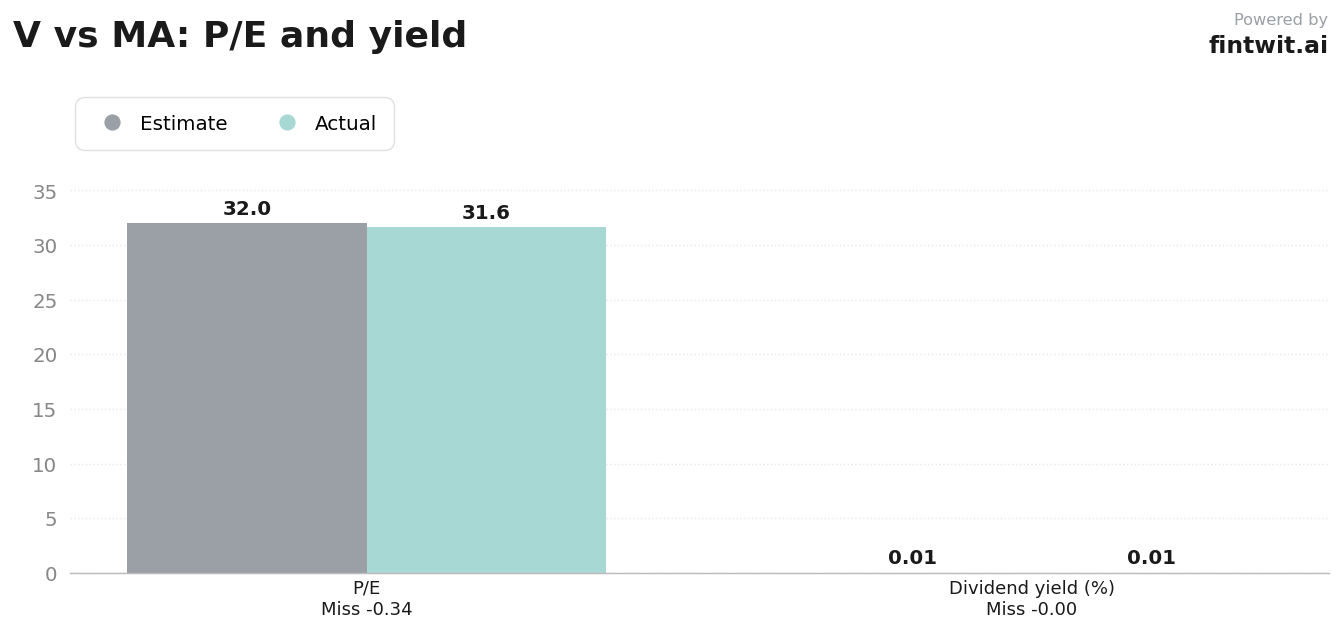
A direct comparison of key financial metrics reveals subtle differences in their current valuations and performance trends. Investors often look at these figures to gauge relative value and growth potential. The chart below provides a visual comparison of their valuation metrics.
Visa's gross profit margin for Q3 2026 was 76.46%, a decrease from its 10-year median of 80.42%. Mastercard's margins have generally remained competitive, reflecting similar operational efficiencies within the duopoly. Both companies maintain high profitability due to their scalable network businesses.
- Market Cap: Visa $700.67 billion vs. Mastercard $503.20 billion
- Price: Visa $375.62 vs. Mastercard $573.27
- P/E Ratio: Visa 31.97x vs. Mastercard 31.63x
- Dividend Yield: Visa 0.72% vs. Mastercard 0.59%
- 1-Year Price Change: Visa +10.47% vs. Mastercard -2.24%
- 90-Day Price Change: Visa +12.76% vs. Mastercard +14.35%
- Visa Q3 2026 Net Revenue: $11.6 billion, up 14% year-over-year
- Visa Q3 2026 Operating Margin: 60.7%, 2.4 percentage points below its three-year average
Bull and bear on each
Both Visa and Mastercard face distinct opportunities and challenges that could influence their stock performance. Understanding these arguments helps in forming a balanced investment perspective. Analyst sentiment remains largely positive for both payment processors.
- Visa Bull Case:
- Continued expansion in value-added services and strategic partnerships will drive diversified growth.
- Resilience and leadership position in the payments industry support an attractive long-term risk-reward.
- Inflation-hedge characteristic, where percentage-based fees increase revenue with inflation, provides a significant advantage.
- Visa Bear Case:
- Operating expenses jumped 17% year-over-year in Q3 2026, including $563 million in severance costs, pressuring margins.
- Client incentives increased 18% in Q3 2026, further impacting profitability.
- Prolonged DOJ debit-card antitrust lawsuit and ongoing insider selling by executives could temper near-term enthusiasm.
- Mastercard Bull Case:
- Mastercard's strong brand and extensive global network continue to drive transaction volume growth.
- Ongoing investments in cybersecurity and data analytics enhance its value proposition to clients.
- Strategic acquisitions and partnerships are expanding its presence in new payment flows and digital solutions.
- Mastercard Bear Case:
- Increased regulatory scrutiny on interchange fees and network practices could impact revenue streams.
- Intensifying competition from fintech innovators and alternative payment methods poses a long-term threat.
- Exposure to geopolitical risks and currency fluctuations in international markets could affect financial performance.
The verdict
Visa maintains a strong competitive position with its expansive network and diversified growth initiatives, despite some recent margin pressures. The company's ability to leverage its global scale and adapt to evolving payment trends supports its long-term outlook. Analyst targets reflect confidence in Visa's future performance, with President Capital setting a target of $474.
Mastercard also presents a compelling investment case, driven by its robust network and strategic focus on innovation. While its recent stock performance has lagged Visa's, its underlying business fundamentals remain solid. The company's efforts to expand into new payment technologies and enhance security features are key drivers.
Considering the financial metrics, competitive advantages, and potential headwinds, both companies offer distinct value propositions. Investors should weigh the growth prospects against the risks, including regulatory challenges and operational costs. The AI model provides a clear differentiation in its assessment of these two payment giants.