Visa Inc. Class A (V) Q3 Earnings Preview: What to Watch
Visa reports fiscal Q3 2026 earnings on July 28. Analysts expect $3.22 EPS as investors monitor cross-border volume and regulatory headwinds.

The setup
Visa continues to benefit from secular tailwinds in digital payments and the expansion of its value-added services. Management previously raised its full-year outlook to low double-digit to low-teens net revenue growth.
The company remains a dominant force in global transaction processing despite increasing regulatory scrutiny. Investors are focused on whether the firm can maintain its historical consistency in earnings delivery.
- Barclays initiated coverage with an Overweight rating and a $420 price target.
- TIKR analysts suggest a mid-case fair value of $687, citing long-term potential in value-added services.
- Perseus Perspectives maintains a Buy rating, labeling the stock a steady compounder.
Consensus numbers
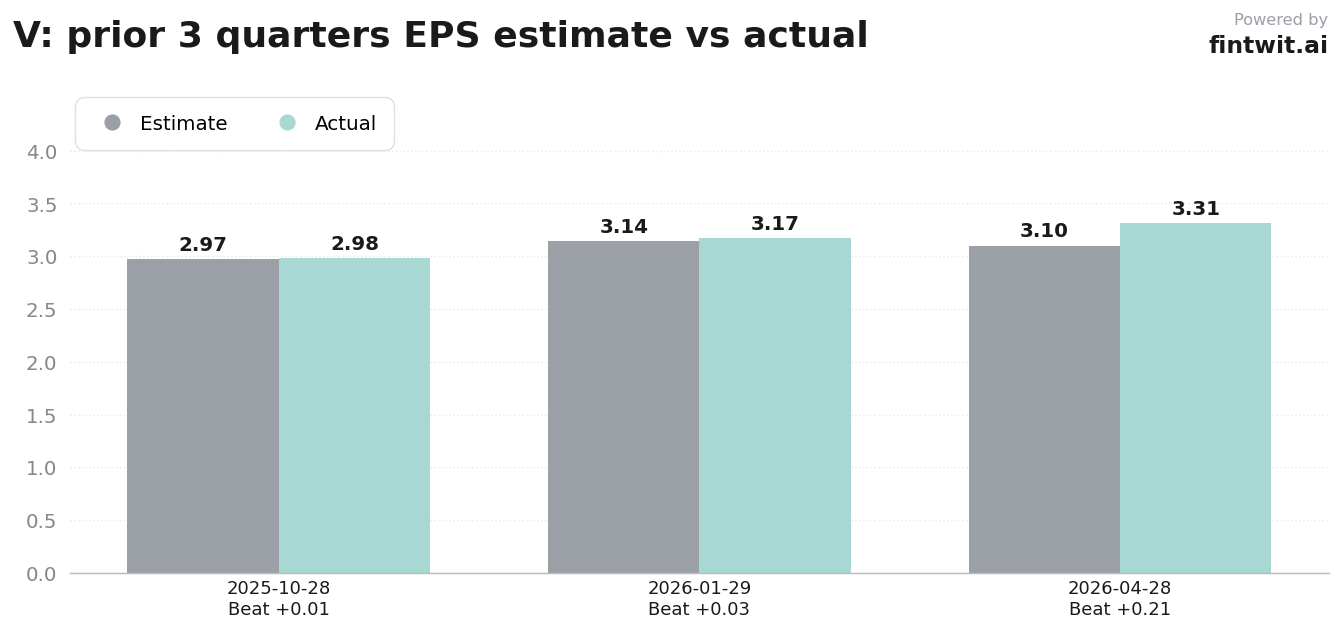
Wall Street consensus estimates for the fiscal third quarter center on steady top and bottom-line growth. The company has a strong track record of exceeding analyst expectations in recent quarters.
The following data points summarize the current market expectations for the upcoming release.
- EPS estimate: $3.22 to $3.23.
- Revenue estimate: $11.38 billion to $11.40 billion.
- Value-Added Services growth: 27% (recent historical benchmark).
- Q1 2026 actual EPS: $3.17 vs $3.14 estimate.
- Q2 2026 actual EPS: $3.31 vs $3.10 estimate.
- Q3 2025 actual EPS: $2.98 vs $2.97 estimate.
What we'll watch on the call
Management will face questions regarding the impact of the Credit Card Competition Act (CCCA) on interchange fees. The duopoly structure of the payment network remains a central point of regulatory debate.
Analysts are also tracking the sustainability of cross-border volume growth. The competitive threat posed by stablecoins and alternative payment rails will likely be addressed during the Q&A session.
- Status of the Credit Card Competition Act and potential margin compression.
- Trends in cross-border volume growth relative to macroeconomic fluctuations.
- Management commentary on stablecoin integration and alternative payment rails.
- Resilience of consumer spending patterns and wage growth impact on transaction volumes.
- Performance of fraud protection and tokenization within the Value-Added Services segment.
Fintwit's AI verdict
The quantitative models suggest that the current market pricing may not fully account for the long-term compounding effect of Visa's service-based revenue streams. While regulatory risks are well-documented, the underlying network strength remains a primary driver for institutional interest.
Investors are weighing the potential for a positive surprise against the backdrop of broader financial sector volatility. The upcoming report will serve as a critical data point for those evaluating the durability of the firm's current growth trajectory.