The top dividend yields right now: who is safe and who is a trap
High yields often signal distress. We break down the sustainability of top dividend payers like ARCC, BCE, and T to help you build a resilient portfolio.

Why these yields right now
Market volatility and sector-specific headwinds have pushed dividend yields to levels not seen in years. High interest rates have forced capital-intensive industries like telecommunications and energy to compete for investor attention through aggressive distribution policies.
However, a high yield is often a reflection of a declining share price rather than a growing business. Investors must look beyond the headline percentage to evaluate the payout ratio relative to free cash flow rather than GAAP earnings.
- ARCC maintains a 9.97% yield, supported by its role as a major direct lender in the middle market.
- BCE Inc. reset its dividend with a 56% cut in May 2025 to prioritize debt reduction and network modernization.
- Western Midstream Partners (WES) offers an 8.63% yield, benefiting from stable cash flows inherent to the midstream energy sector.
The top yielders
The following list highlights companies currently providing yields above 9%. Sustainability varies significantly based on industry structure and cash flow coverage.
Investors should prioritize companies with consistent cash flow generation over those relying on special dividends or debt-funded payouts.
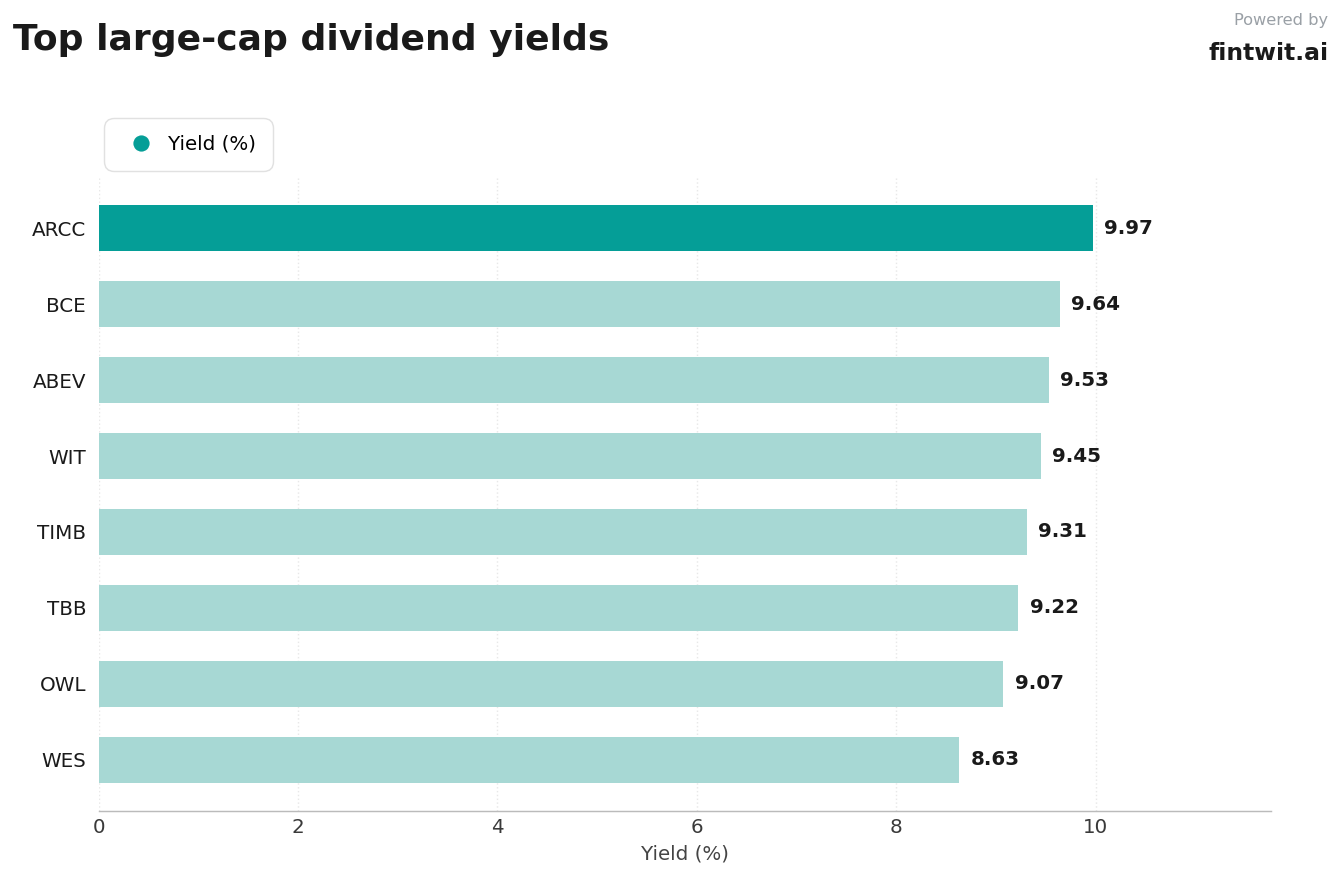
- ARCC: 9.97% yield, 117.79% payout ratio, moderate safety rating.
- BCE: 9.64% yield, 70.3% payout ratio, improved safety rating post-reset.
- ABEV: 9.53% yield, 62.47% payout ratio, moderate safety rating.
- WIT: 9.45% yield, 87.29% payout ratio, low safety rating.
- TIMB: 9.31% yield, variable payout ratio, low safety rating.
- T: 9.22% yield, 40% payout ratio, moderate safety rating.
- OWL: 9.07% yield, 675.36% payout ratio, low safety rating.
- WES: 8.63% yield, 77.43% payout ratio, moderate safety rating.
Yield traps
A yield trap occurs when a company's dividend yield appears attractive but is unsustainable due to fundamental business decline or excessive leverage. These stocks often trade at low valuations because the market anticipates a dividend cut.
Investors should be wary of companies with payout ratios exceeding 100% of earnings or those that rely on irregular special distributions to maintain their yield profile.
- OWL: Extremely high earnings-based payout ratio of 675.36% indicates potential sustainability issues.
- WIT: Inconsistent dividend history and high payout ratio of 87.29% suggest low reliability.
- TIMB: Dividend sustainability is highly dependent on board-declared special distributions rather than recurring operational cash flow.
- WES: High earnings-based payout ratio of 121.57% requires careful monitoring of cash flow coverage.
Build an income sleeve
Constructing a resilient income portfolio requires balancing high-yield assets with those that demonstrate consistent dividend growth. Diversification across sectors like energy, finance, and telecommunications can mitigate the impact of a single dividend cut.
Focus on companies with payout ratios below 75% of free cash flow to ensure the dividend remains covered during economic downturns. Avoid chasing the highest yield without verifying the underlying financial health of the issuer.
- Prioritize companies with at least 4 years of consecutive dividend growth, such as Blue Owl Capital.
- Monitor K-1 tax form requirements for MLP structures like WES before adding to taxable accounts.
- Evaluate the impact of capital expenditure requirements on dividend sustainability for telecom firms like AT&T.