Salesforce (CRM) vs Oracle (ORCL): Which Enterprise Tech Giant is the Better Buy?
Salesforce and Oracle are battling for enterprise AI dominance. We break down the financials and growth catalysts to see which stock is the superior buy.
The matchup
Salesforce (CRM) and Oracle (ORCL) represent two distinct paths to enterprise AI monetization. Salesforce focuses on embedding agentic AI into its existing Customer 360 platform, while Oracle is building the underlying infrastructure required to train and deploy these models at scale.
Salesforce relies on its massive installed base of 150,000 customers to drive cross-sell opportunities through its Agentforce platform. Oracle, conversely, is betting on its RDMA networking and high-performance cloud database capabilities to capture mission-critical workloads.
The competitive landscape is shifting from traditional software licensing to consumption-based AI revenue. Both firms are aggressively reallocating capital to secure their positions in the enterprise stack.
- Salesforce (CRM) market cap: $183.07 billion.
- Oracle (ORCL) market cap: $430.49 billion.
- Salesforce 1-year price change: -33.55%.
- Oracle 1-year price change: -50.07%.
Numbers side by side
Financial performance diverges significantly when looking at revenue growth and margin profiles. Oracle is currently outpacing Salesforce in top-line expansion, driven by its cloud infrastructure build-out.
Salesforce maintains superior operational efficiency, evidenced by its 34.8% non-GAAP operating margin in Q1 FY27. Oracle faces higher capital intensity as it funds massive data center expansion, pressuring its gross margins.
Investors must weigh Salesforce's stable free cash flow against Oracle's explosive, albeit debt-funded, growth trajectory.
- Revenue Growth: Salesforce 13% YoY vs. Oracle 21% YoY.
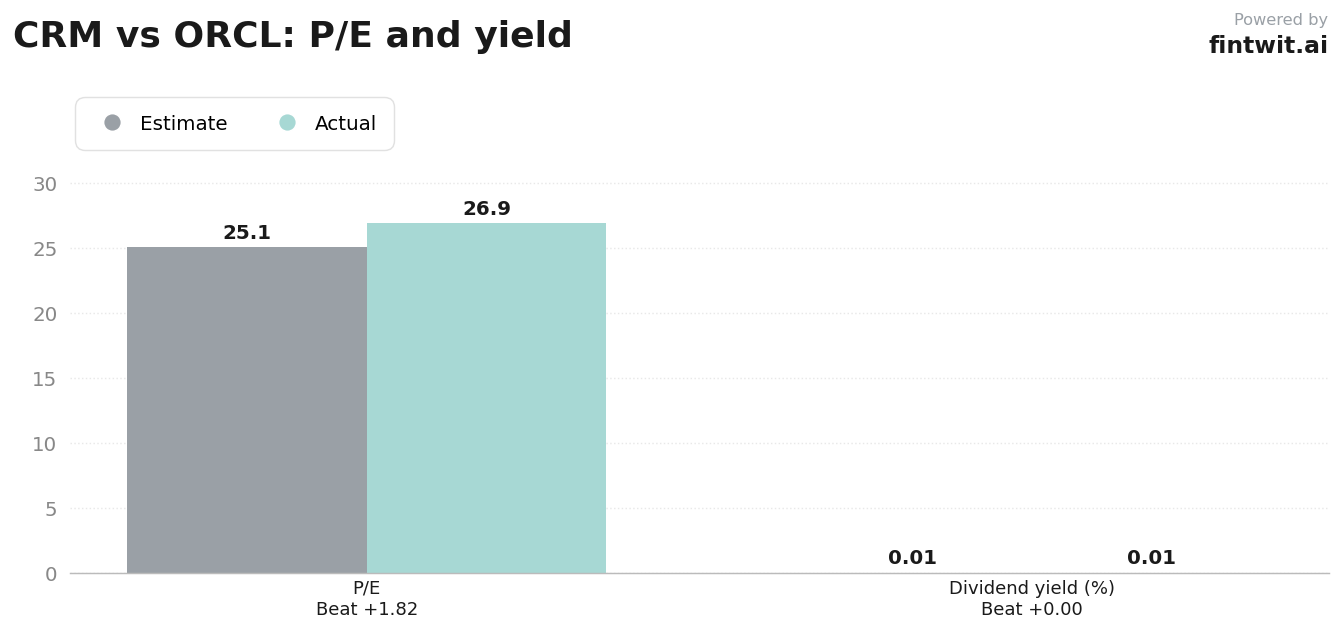
- P/E Ratio: Salesforce 25.05 vs. Oracle 26.87.
- Dividend Yield: Salesforce 0.85% vs. Oracle 1.29%.
- RPO Visibility: Salesforce $67.9B vs. Oracle $638B.
Bull and bear on each
The bull case for Salesforce centers on the successful integration of Agentforce into its massive customer ecosystem. Bearish sentiment focuses on slowing organic growth and the execution risks inherent in large-scale M&A.
Oracle's bull case is built on its integrated stack, which provides a unique value proposition for security-conscious enterprises. The bear case highlights the company's rising debt levels and the potential for margin compression due to infrastructure costs.
Analyst sentiment remains mixed, with firms like Morgan Stanley and Goldman Sachs closely monitoring the impact of digital labor on long-term margins.
- CRM Bull: Agentic AI drives significant cross-sell and upsell.
- CRM Bull: $25B ASR program supports EPS growth.
- CRM Bear: Slowing organic growth rates compared to historical peaks.
- ORCL Bull: Cloud Infrastructure (IaaS) growth remains explosive.
- ORCL Bull: Integrated stack offers superior performance for mission-critical apps.
- ORCL Bear: Extreme capital intensity and rising debt levels.
The verdict
Oracle's superior revenue growth and critical role in AI infrastructure provide a more compelling growth narrative. While Salesforce offers a more stable software-centric model, Oracle's massive RPO suggests a longer runway for expansion.
The ultimate winner depends on whether the market prioritizes infrastructure utility or software-based workflow automation. Investors should monitor upcoming quarterly reports for signs of margin stabilization in Oracle's cloud division.