NVIDIA (NVDA) vs Advanced Micro Devices (AMD): Which Is the Better Buy in 2026?
We compare NVIDIA and AMD to determine which semiconductor giant offers the most compelling risk-reward profile for AI-focused portfolios.
The matchup
NVIDIA maintains a dominant position in the AI infrastructure market through its full-stack ecosystem, which includes CUDA, NVLink, and advanced networking. This creates high switching costs for enterprise clients and ensures superior performance-per-watt for data center workloads.
AMD competes by offering a robust CPU and GPU portfolio, leveraging strategic partnerships with hyperscalers like Meta, AWS, and Google. The company is currently focused on scaling its AI infrastructure to challenge the incumbent's market share.
- NVIDIA's moat is built on the CUDA software ecosystem, which remains the industry standard for AI developers.
- AMD's growth is driven by the MI450 and EPYC product lines, targeting cost-effective inference workloads.
- NVIDIA reported 85% YoY revenue growth in Q1 2027, highlighting the massive demand for its Blackwell and Rubin platforms.
- AMD posted 38% YoY revenue growth in Q1 2026, reflecting its ongoing efforts to capture server market share.
Numbers side by side
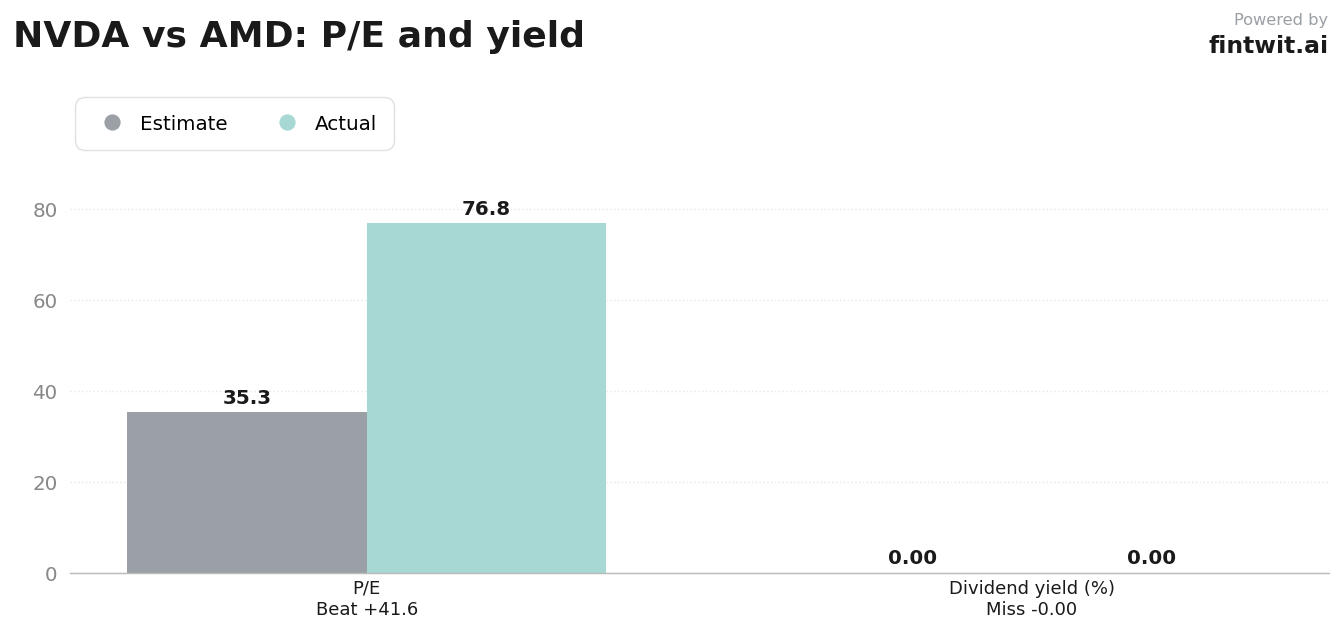
The valuation gap between the two companies reflects their differing market positions and growth trajectories. NVIDIA trades at a P/E ratio of 35.29, while AMD commands a higher P/E of 76.84, indicating market expectations for accelerated growth.
Profitability metrics further distinguish the two, with NVIDIA maintaining GAAP gross margins near 75% compared to AMD's 55%.
- NVIDIA Market Cap: $4.20 trillion.
- AMD Market Cap: $328.25 billion.
- NVIDIA 1-Year Return: 44.82%.
- AMD 1-Year Return: 323.83%.
- NVIDIA Dividend Yield: 0.0002%.
- AMD Dividend Yield: 0.0000%.
Bull and bear on each
Analysts remain divided on the sustainability of current valuation multiples given the rapid pace of AI infrastructure deployment.
The following points summarize the consensus views from firms including Morningstar, Baird, and Bernstein.
- NVIDIA Bull: Dominance in AI infrastructure with Blackwell/Rubin platforms.
- NVIDIA Bull: Unmatched software ecosystem (CUDA) locking in developers.
- NVIDIA Bear: High valuation multiples susceptible to market volatility.
- NVIDIA Bear: Potential for AI infrastructure spending to moderate in late 2027.
- AMD Bull: Accelerating Data Center growth driven by MI450 and EPYC CPUs.
- AMD Bull: Strong momentum in custom silicon and rack-scale platforms.
- AMD Bear: Software ecosystem (ROCm) still trailing the CUDA standard.
- AMD Bear: Margin pressure resulting from competitive pricing strategies.
The verdict
NVIDIA's superior full-stack ecosystem and unmatched profitability provide a more durable competitive advantage in the current AI era. The company's ability to maintain high margins while scaling production remains a key differentiator for long-term investors.
AMD remains a viable alternative, particularly if the AI market shifts heavily toward price-sensitive inference workloads. Its cost-to-performance ratio could become the industry standard if open-source software support gains significant traction.