Intel Corporation (INTC) Q2 2026 Earnings Preview: What to Watch
Intel reports Q2 2026 earnings on July 23. Analysts focus on 18A process yields, data center momentum, and PC market health.
The setup
Intel is currently navigating a high-stakes transformation as it attempts to regain its technological edge in the semiconductor industry. The company's narrative is defined by a delicate balance between capturing AI-driven data center demand and managing the capital-intensive ramp of its foundry business.
Recent volatility has characterized the stock's performance, with investors closely monitoring the sustainability of margin expansion. The market is looking for concrete evidence that Intel can compete effectively against AMD and custom silicon providers while maintaining its manufacturing roadmap.
- Key focus area: The 18A process node yield trajectory and its impact on long-term foundry competitiveness.
- Macro environment: Hyperscaler capital spending remains a critical driver for Data Center and AI (DCAI) segment growth.
- Competitive landscape: Intensifying pressure from ARM-based architectures and in-house silicon designs by major cloud providers.
- Analyst sentiment: KeyBanc maintains a Buy rating with a $155 target, while HSBC has set a $200 target based on 2026-2027 EPS projections.
Consensus numbers
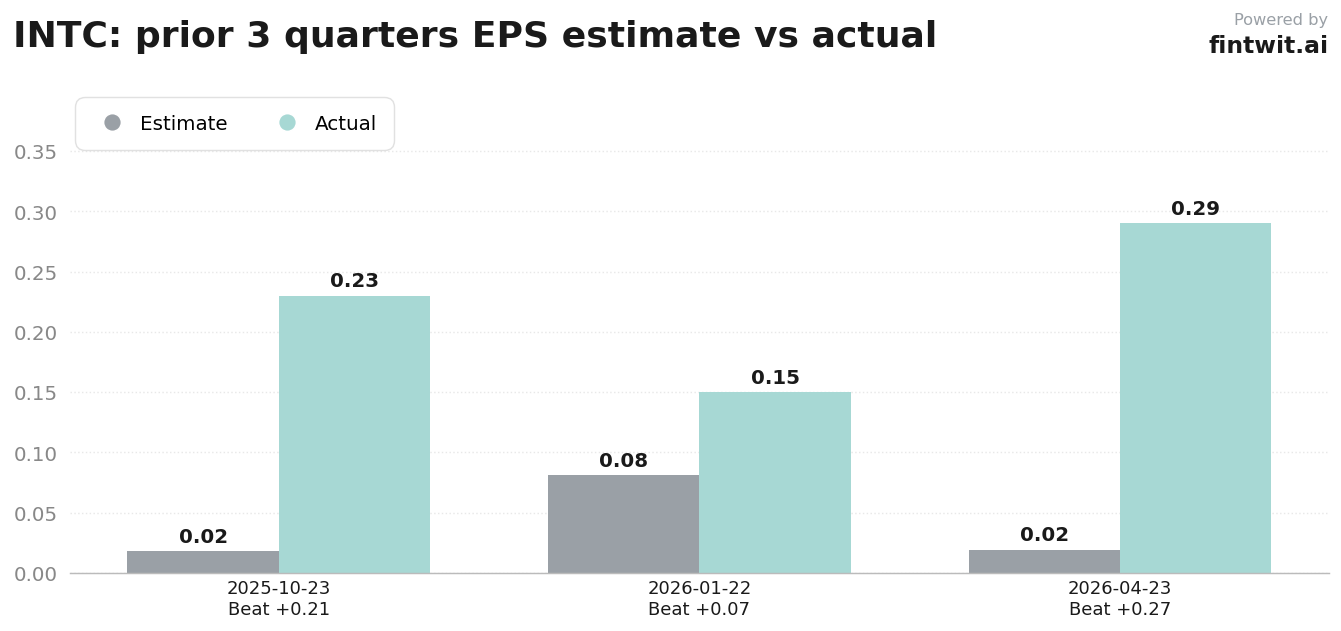
Wall Street expects Intel to report adjusted EPS of $0.21 on revenue of $14.42 billion for the second quarter of 2026. This follows a trend of consistent earnings surprises over the last three quarters.
Management's previous guidance for Q2 2026 set a revenue range of $13.8 billion to $14.8 billion. Investors will compare these results against the historical performance of the company's core segments.
- Q2 2026 EPS Estimate: $0.21.
- Q2 2026 Revenue Estimate: $14.42 billion.
- Q1 2026 Actual EPS: $0.29 (vs $0.019 estimate).
- Q4 2025 Actual EPS: $0.23 (vs $0.018 estimate).
- Q3 2025 Actual EPS: $0.15 (vs $0.081 estimate).
What we'll watch on the call
The earnings call will serve as a litmus test for the company's operational efficiency and strategic pivot. Management commentary regarding the second half of 2026 will be scrutinized for signs of margin durability.
Analysts are particularly interested in how the company plans to balance its pricing strategies against cost-saving initiatives. The ability to maintain server CPU market share remains a primary concern for institutional investors.
- 18A process node: Status of yield improvements and external foundry customer adoption.
- DCAI segment: Ability to capture AI infrastructure demand despite internal workforce restructuring.
- CCG segment: Outlook for PC demand in H2 2026, specifically regarding memory cost headwinds.
- Gross margins: Sustainability of current levels and the impact of capital spending plans.
- Christopher Rolland of Susquehanna: Warns of potential H2 weakness due to rising memory prices.
Fintwit's AI verdict
The market sentiment surrounding Intel remains cautious as the company attempts to execute its complex foundry strategy. While recent earnings beats have provided some optimism, the long-term viability of the 18A process and competitive pressures in the data center space keep the outlook balanced.
Investors are waiting for a clear signal that the capital-intensive transition is yielding tangible financial results before committing to a more aggressive position.