The Home Depot Inc (HD) vs Lowe's Companies Inc (LOW): Better Buy in 2026?
Comparing The Home Depot and Lowe's: Which retail giant is the superior long-term play for your portfolio in 2026?
The matchup
The home improvement sector faces a complex environment defined by the housing lock-in effect and shifting discretionary spending patterns. Both companies are aggressively pursuing the professional contractor market to offset sluggish DIY demand.
The Home Depot relies on its massive scale and recent strategic acquisitions like SRS and GMS to capture high-value renovation projects. Lowe's is executing a Total Home strategy, focusing on its reputation among DIY consumers while attempting to scale its own Pro-focused acquisitions.
- The Home Depot market capitalization stands at $319.31 billion.
- Lowe's market capitalization is $126.01 billion.
- Both retailers are navigating a $1.2 trillion addressable market.
- Pro-focused strategy remains the primary growth engine for both firms.
Numbers side by side
Valuation metrics highlight a distinct divergence in how the market prices these two competitors. While HD trades at a premium, its operational efficiency and margin profile justify the higher multiple.
Lowe's presents a more attractive entry point for value-oriented investors, though it carries higher integration risks from its recent acquisition activity.
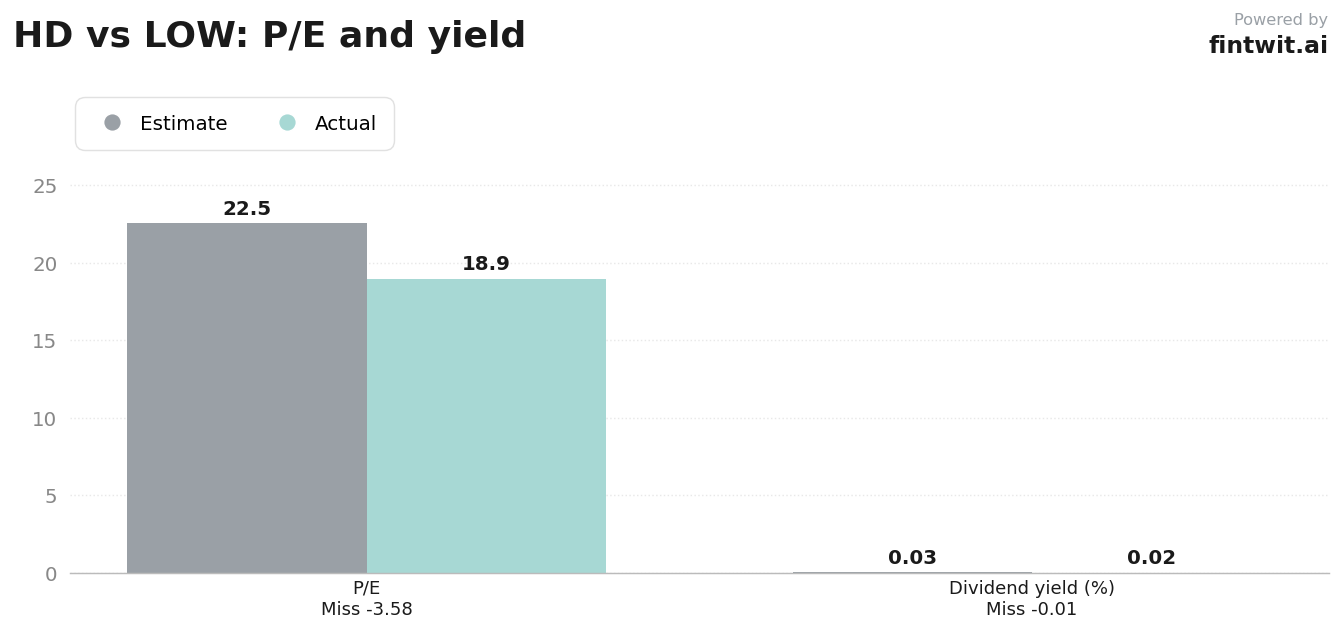
- HD P/E Ratio: 22.52x.
- LOW P/E Ratio: 18.94x.
- HD Dividend Yield: 2.81%.
- LOW Dividend Yield: 2.07%.
- HD Revenue Growth: 4.8% YoY (Q1 2026).
- LOW Revenue Growth: 10.2% YoY (Q1 2026).
- HD Adjusted Operating Margin Guidance: 12.8%–13.0%.
- LOW Adjusted Operating Margin Guidance: 11.6%–11.8%.
Bull and bear on each
Each company faces unique headwinds and tailwinds as they integrate recent acquisitions and manage distribution costs.
Analysts remain generally constructive on both, though the target price consensus favors the long-term potential of HD.
- HD Bull: Successful integration of SRS/GMS expands addressable market to $1.2T.
- HD Bull: Pro-focused strategy captures high-value, recurring renovation spend.
- HD Bear: Persistent housing market lock-in effect limits big-ticket discretionary projects.
- HD Bear: Margin pressure from heavy acquisition integration and higher distribution costs.
- LOW Bull: Aggressive expansion into Pro market via FBM/ADG acquisitions.
- LOW Bull: Lower valuation (P/E ~18.9) offers better entry point for value investors.
- LOW Bear: Higher sensitivity to DIY consumer spending volatility.
- LOW Bear: Integration risks and margin dilution from large-scale acquisitions.
- UBS rates HD as a positive with a $450 price target.
- Wall Street consensus for LOW sits at a $269.13 price target.
The verdict
The Home Depot demonstrates superior structural resilience, making it the preferred choice for investors prioritizing long-term stability and Pro-market dominance. Its ability to maintain margins during a period of heavy integration suggests a more robust operational foundation.
Lowe's remains a compelling alternative for investors seeking a lower valuation and potential upside from its Total Home strategy. The outcome for Lowe's depends heavily on its ability to convert DIY momentum into consistent Pro-market growth.