Fintech Disruption: Why V, MA, and HOOD Are Leading the Financial Infrastructure Shift
The fintech sector is evolving from disruptive experimentation to systemic integration. We break down the key players and risks in this financial shift.

The thesis
The financial services sector is undergoing a fundamental transition from fragmented, workflow-based tools to integrated, autonomous financial ecosystems. This evolution is driven by the deployment of AI at scale, which allows platforms to automate complex money movement and decision-making.
Frank Medrano of J.P. Morgan notes that money movement remains the sector's defining theme. By embedding payments directly into software, these platforms transform simple workflow tools into powerful revenue engines that capture more of the customer journey.
Why now
The industry is entering a resurgence phase characterized by a pivot toward profitability and consolidation. Companies that successfully own the underlying infrastructure are gaining significant competitive advantages over legacy intermediaries.
According to BCG, the shift from recovery to resurgence is defined by the ability to leverage AI to reduce operational friction. This capability is becoming the primary differentiator for market leaders in 2026.
Stocks we're watching
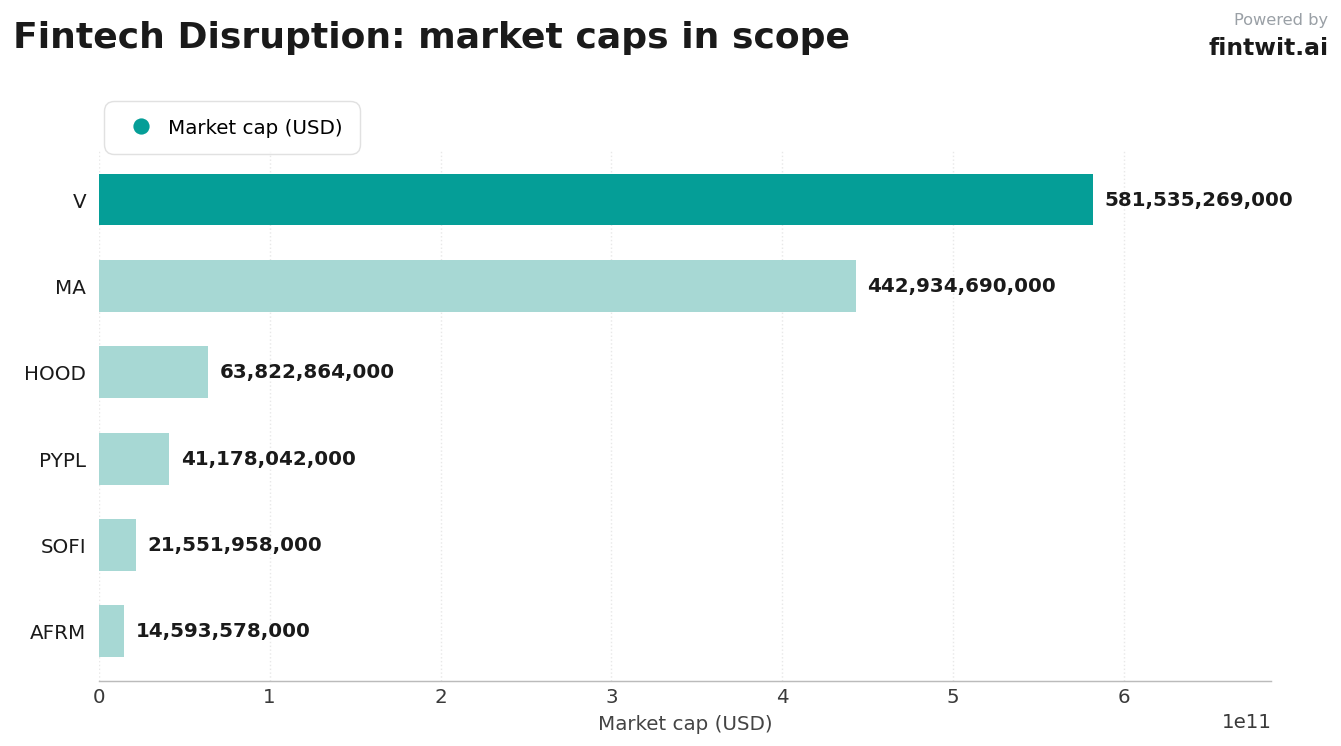
The following firms represent the core infrastructure and consumer-facing leaders currently driving the fintech sector's evolution.
- Visa (V): Acts as the global payment infrastructure, maintaining a dominant, high-margin moat as the foundational rail for digital transactions.
- Mastercard (MA): Leverages massive scale and network effects to remain the essential backbone of international commerce.
- PayPal (PYPL): Pivoting toward becoming a comprehensive, AI-enhanced platform for consumer and merchant money movement.
- SoFi (SOFI): Integrates lending, banking, and investment services into a single, high-growth digital ecosystem.
- Affirm (AFRM): Capitalizes on the shift toward point-of-sale credit by embedding financing directly into the e-commerce checkout flow.
- Robinhood (HOOD): Democratizes financial market access through a mobile-first, low-friction interface that appeals to the next generation of investors.
Risks that break it
The path to systemic integration is not without significant operational and macroeconomic hurdles. Investors must monitor how these firms manage regulatory and security pressures.
- Regulatory fragmentation and tightening compliance requirements, such as Section 1033 open banking rules, are creating increased operational friction.
- Escalating cybersecurity threats, particularly AI-enabled fraud and social engineering, continue to erode consumer trust and increase institutional liability.
- Macroeconomic sensitivity remains a concern, as high interest rates and potential recessionary pressures disproportionately impact the credit quality of fintech lending portfolios.