Fifth Third Bancorp (FITB) Q2 Earnings Preview: What to Watch
Fifth Third Bancorp (FITB) reports Q2 2026 earnings on July 17. Analysts expect $0.84 EPS as the market monitors Comerica integration and credit quality.
The setup
Fifth Third Bancorp enters the second quarter of 2026 with significant momentum driven by the ongoing integration of the Comerica acquisition. Management reaffirmed its full-year guidance in June, targeting net interest income between $8.6 billion and $8.8 billion.
The bank is balancing aggressive expansion with a complex macroeconomic backdrop. Investors are focused on whether the firm can maintain its net charge-off ratio within the projected 30 to 40 basis point range.
Market sentiment remains bullish as major firms adjust their outlooks. The consensus narrative suggests that while merger-related expenses may weigh on GAAP results, the underlying operational efficiency is improving.
- Wells Fargo (Mike Mayo): Overweight rating, price target raised to $67.
- UBS (Erika Najarian): Buy rating, price target raised to $65.
- Morgan Stanley (Manan Gosalia): Overweight rating, price target raised to $64.
- Full-year noninterest expense guidance remains fixed at $7.2 billion to $7.3 billion.
Consensus numbers
Wall Street expects Fifth Third to report earnings of $0.84 per share for the second quarter. Revenue estimates are currently pegged at $3.25 billion.
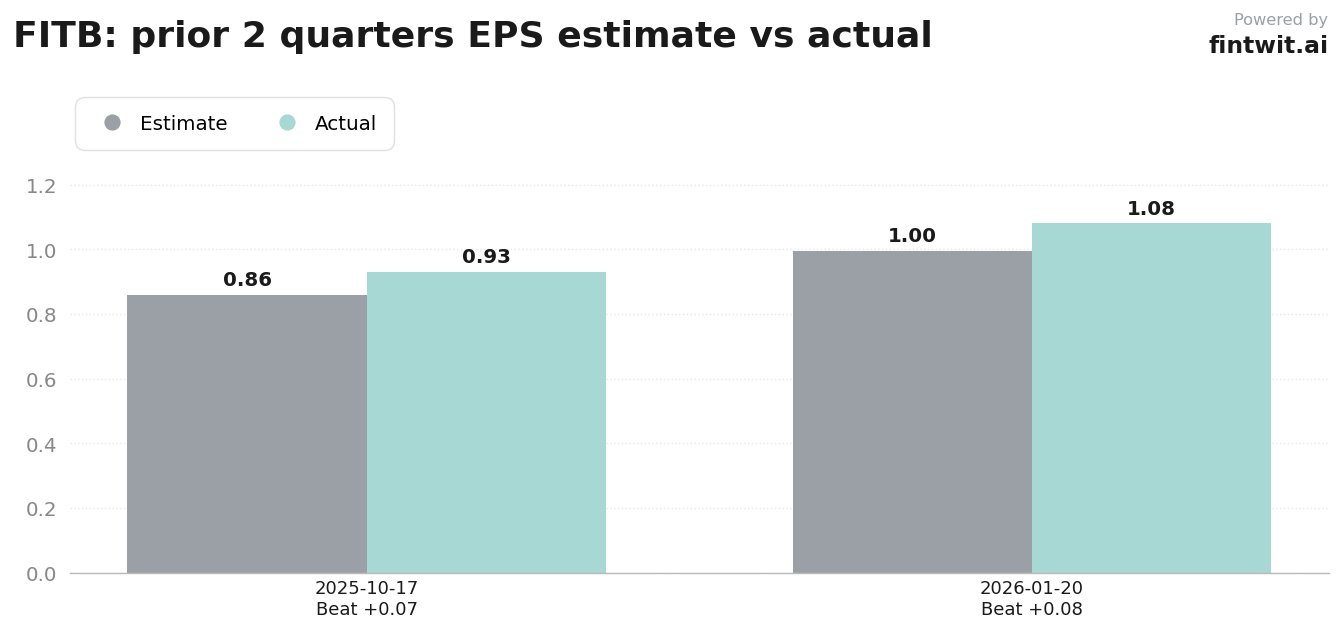
The bank has a history of outperforming analyst expectations in recent quarters. The following data highlights the recent trend of earnings surprises.
Growth in noninterest income remains a critical component of the revenue forecast. This is supported by continued expansion in commercial payments and Newline deposit balances.
- Q2 2026 EPS Estimate: $0.84.
- Q2 2026 Revenue Estimate: $3.25 billion.
- Q4 2025 Actual EPS: $0.93 (vs $0.86 estimate).
- Q1 2026 Actual EPS: $1.08 (vs $1.00 estimate).
- Beat probability: 65%.
- Miss probability: 15%.
What we'll watch on the call
The primary focus for analysts will be the progress of the Comerica branch and system conversions. Management must demonstrate that cost synergies are being realized at the projected pace.
Credit quality remains a top-of-mind concern for institutional investors. The call will likely address how the bank is adjusting its provisions for credit losses in response to shifting geopolitical and macroeconomic risks.
Digital strategy is also under the microscope. Specifically, the impact of the new AI-powered mobile app feature on customer engagement and retention will be a key metric for long-term growth.
- Timeline for Comerica branch and system integration.
- Evolution of credit provision expectations relative to economic outlook.
- Management of deposit attrition and funding costs post-acquisition.
- Sensitivity of wealth management fee income to S&P 500 performance.
- Impact of interest rate environment on net interest margin expansion.
Fintwit's AI verdict
The quantitative model suggests that the current market pricing does not fully account for the long-term efficiency gains expected from the Comerica integration. While short-term GAAP volatility is anticipated due to merger expenses, the underlying core banking business shows resilience.
Investors should monitor the bank's ability to maintain its net interest margin as the interest rate environment fluctuates. The combination of strong fee income growth and disciplined expense management positions the firm favorably for the remainder of the fiscal year.