Deere & Company (DE) vs Caterpillar Inc (CAT): Which Is the Better Buy in 2026?
Deere and Caterpillar face distinct cycles. We break down the data to see which industrial leader offers more upside for your portfolio.
The matchup
Deere & Company operates at the intersection of agriculture and construction, currently navigating a cyclical downturn in large-scale farming. The company relies on its proprietary precision agriculture software and a massive North American dealer network to maintain high-margin aftermarket revenue.
Caterpillar serves as a global bellwether for infrastructure, mining, and energy. Its recent performance is bolstered by a record $63 billion backlog and surging demand for power generation equipment, specifically for data center infrastructure.
- Deere (DE) market cap: $166.93 billion.
- Caterpillar (CAT) market cap: $318.64 billion.
- Deere primary focus: Farm and heavy construction machinery.
- Caterpillar primary focus: Construction, mining, and energy/transportation.
Numbers side by side
Valuation metrics reveal a premium market sentiment for both firms, though their growth drivers differ significantly. Caterpillar's recent volume growth has outpaced Deere's, reflecting the strength of its diversified industrial portfolio.
Investors should note the disparity in recent price performance and dividend yields. The following data highlights the current financial standing of both entities.
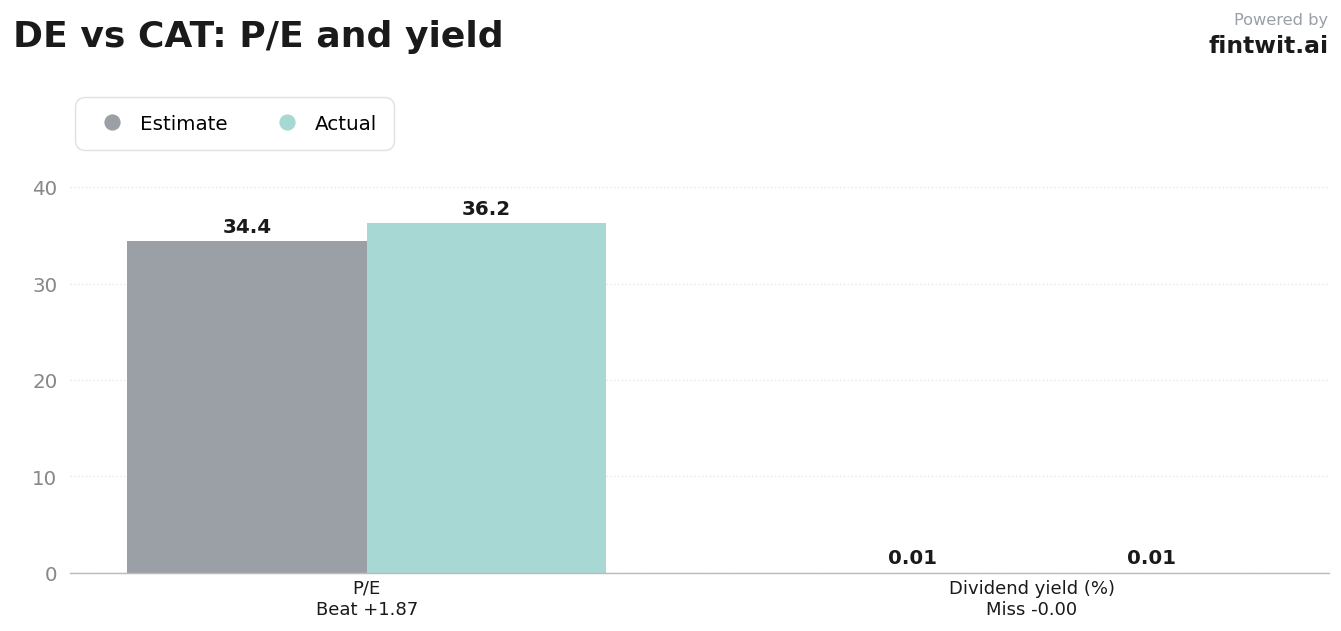
- P/E Ratio: DE 34.37 vs CAT 36.24.
- Dividend Yield: DE 1.06% vs CAT 0.86%.
- 1-Year Price Change: DE 14.32% vs CAT 84.73%.
- 90-Day Price Change: DE 1.63% vs CAT -9.10%.
- Operating Margin: DE ~14% TTM vs CAT 18% (Q1 2026).
Bull and bear on each
Deere's outlook depends on the timing of the agricultural cycle bottom. Conversely, Caterpillar's trajectory is tethered to the pace of global electrification and data center construction.
Analyst sentiment remains generally positive, though specific price targets vary based on macroeconomic assumptions.
- DE Bull Case: 2026 marks the bottom of the large agricultural cycle, setting the stage for a multi-year recovery.
- DE Bull Case: Technology-driven margin expansion through See & Spray provides higher through-cycle profitability.
- DE Bear Case: Prolonged agricultural downturn due to low crop prices and input cost volatility.
- DE Bear Case: Uncertainty regarding global trade policies and tariff impacts on manufacturing costs.
- CAT Bull Case: Record $63B backlog and strong demand for power generation equipment driven by data center expansion.
- CAT Bull Case: Significant capacity investments in large reciprocating engines capture secular energy demand.
- CAT Bear Case: Regulatory risks and permitting hurdles for data centers could curb future power generation demand.
- CAT Bear Case: Cyclical exposure to mining and construction remains sensitive to global economic slowdowns.
- Analyst Take (DE): Jerry Revich (Wells Fargo) Buy, $750 target.
- Analyst Take (CAT): Baird Analyst Neutral, $900 target.
The verdict
Caterpillar offers a more compelling growth narrative for 2026 due to its direct exposure to the data center power boom. While Deere remains a high-quality operator, its reliance on the agricultural cycle introduces higher volatility in the near term.
Investors should weigh the stability of Deere's aftermarket revenue against the explosive growth potential of Caterpillar's energy segment. The choice depends on whether one prefers a cyclical recovery play or a secular growth beneficiary.