Chevron Corp (CVX) Q2 2026 Earnings Preview: What to Watch
Chevron (CVX) faces a pivotal Q2 earnings report on July 31. Analysts are watching for production growth and the reversal of Q1 derivative timing effects.
The setup
Chevron enters the Q2 earnings cycle with a market capitalization of approximately $403.3 billion. The primary narrative centers on the unwinding of roughly $1 billion in derivative timing effects and legal charges that hampered the previous quarter.
Management maintains a focus on capital discipline and a structural cost reduction target of $3 to $4 billion. Investors are evaluating whether the company can successfully integrate the Hess acquisition while maintaining operational reliability across its global assets.
- BofA Securities raised its price target for CVX to $227 from $210.
- Wall Street consensus maintains a Moderate Buy rating with a mean target of $212.81.
- MarketBeat analysts highlight a 65% probability of an EPS beat based on historical performance.
Consensus numbers
Wall Street expects a rebound in profitability compared to the $1.41 EPS reported in Q1 2026. Revenue estimates for the second quarter are currently pegged at $62.72 billion.
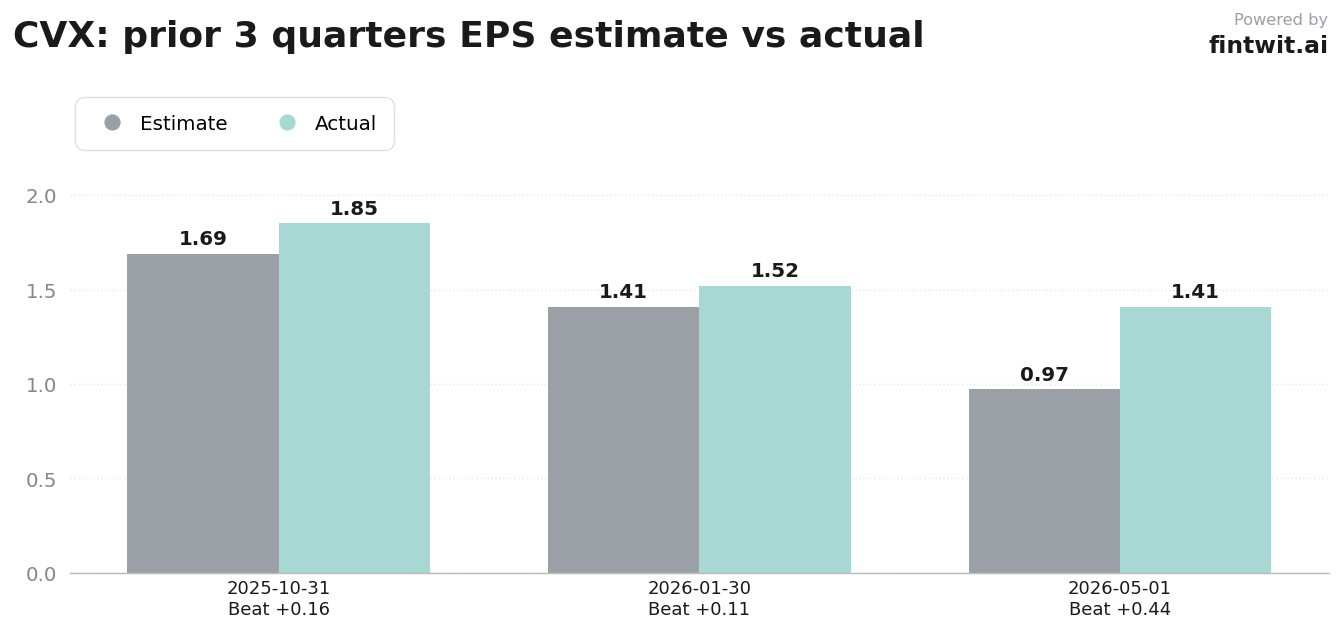
The company has demonstrated a consistent ability to exceed analyst expectations over the last three quarters. This track record remains a critical component of the current valuation thesis.
- Consensus EPS estimate: $5.55.
- Consensus revenue estimate: $62.72 billion.
- Q1 2026 actual EPS: $1.41 vs. $0.973 estimate.
- Q1 2026 actual revenue: $48.61 billion vs. $51.86 billion estimate.
- Q4 2025 actual EPS: $1.52 vs. $1.41 estimate.
- Q3 2025 actual EPS: $1.85 vs. $1.69 estimate.
What we'll watch on the call
The upstream segment remains the primary driver of earnings leverage. Analysts are specifically looking for production updates from the Tengizchevroil project in Kazakhstan and the Permian Basin.
Downstream performance will be scrutinized for refining margin trends. Management commentary regarding geopolitical risks in Venezuela and Iraq will likely influence the stock's volatility post-report.
- Extent of the $1 billion derivative timing effect reversal into Q2 profit.
- Production growth trajectory for TCO and U.S. shale assets.
- Capital allocation strategy for potential new international investments.
- Impact of Middle East and Venezuelan geopolitical tensions on long-term asset security.
- Global refining capacity constraints and their effect on downstream margins.
Fintwit's AI verdict
The quantitative model suggests that the current market pricing does not fully account for the anticipated operational efficiency gains and the normalization of derivative impacts. While geopolitical risks remain a persistent overhang, the company's ability to generate cash flow in a volatile commodity environment provides a defensive floor for the stock price.
Investors should monitor the $212.81 consensus price target as a baseline for post-earnings sentiment. The combination of structural cost reductions and production ramp-ups creates a compelling setup for the upcoming quarter.