The Cheapest Large Caps Right Now: A P/E Screen of 10 Value Stocks
A deep dive into 10 large-cap stocks with P/E ratios under 8. We separate sentiment-driven discounts from fundamental value traps.

How we screened
We filtered the universe of large-cap equities for companies with a market capitalization exceeding $10 billion and a price-to-earnings (P/E) ratio below 8.0. This screen highlights companies currently ignored or punished by the broader market.
Our analysis distinguishes between earned discounts—where fundamental business deterioration justifies a low multiple—and unearned discounts, where sentiment or sector rotation has pushed prices below intrinsic value.
The list
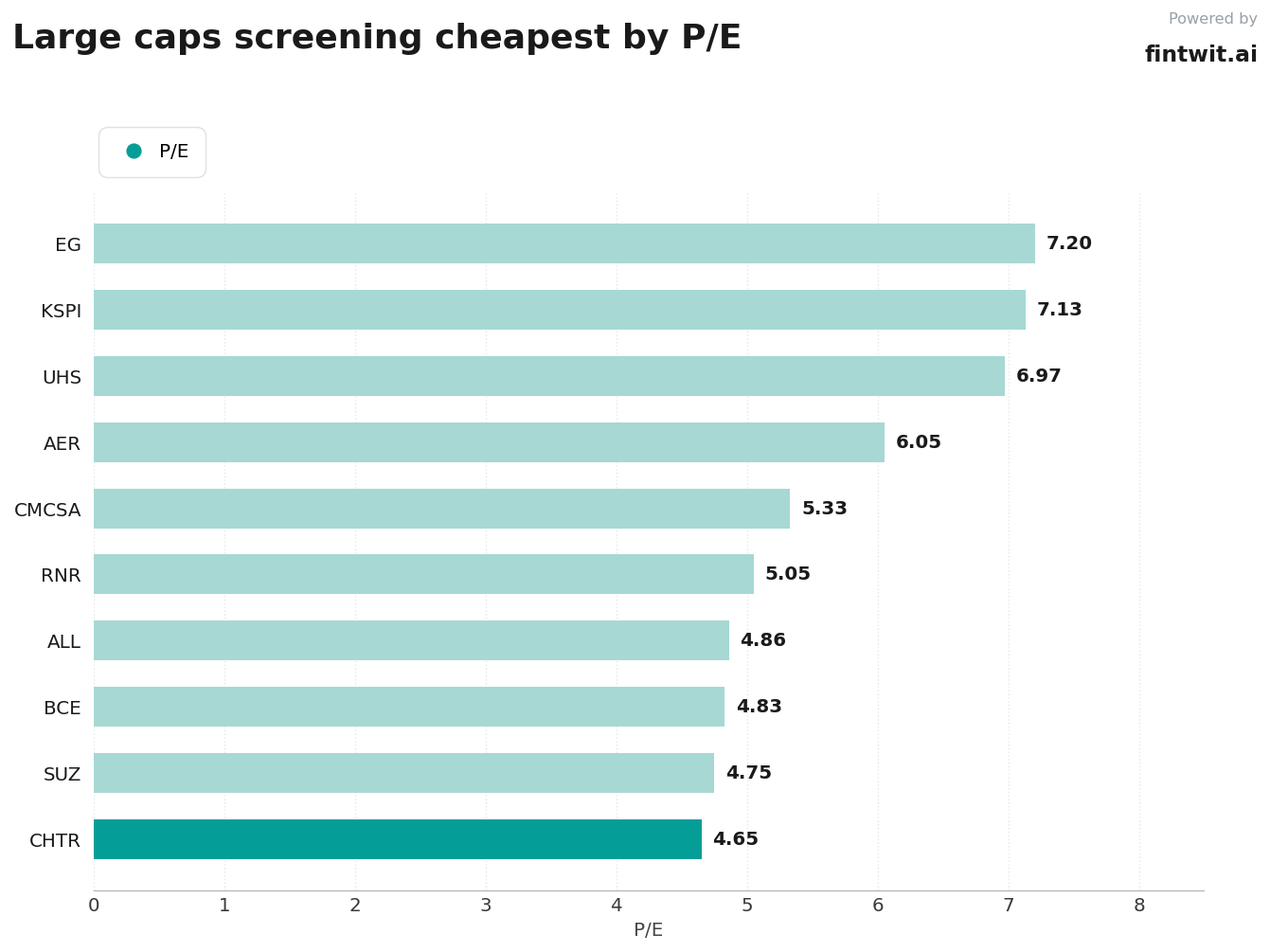
The following tickers represent the most compressed valuations in our dataset. Each entry includes the current P/E ratio and the primary driver behind the valuation gap.
- CHTR (4.65 P/E): Persistent broadband subscriber losses and high CapEx. B of A Securities lowered price target from $250 to $200.
- SUZ (4.75 P/E): Weaker pulp markets and slow deleveraging. Analysts note deleveraging remains a priority but is difficult under current conditions.
- BCE (4.83 P/E): Dividend cut in 2025 and high debt. Zacks notes the stock currently lacks momentum.
- ALL (4.86 P/E): Market concerns regarding event risk. Finimize suggests investors are ignoring capital return potential.
- RNR (5.05 P/E): High short-term volatility. Danelfin notes strong fundamentals are currently offset by negative industry sentiment.
- CMCSA (5.33 P/E): Declining cable subscribers. Rosenblatt Securities upgraded to Buy, citing easing investor concerns.
- AER (6.05 P/E): Sector rotation into AI. Analysts argue current pressure stems from sentiment rather than fundamental weakness.
- UHS (6.97 P/E): Market pressure on behavioral health. Simply Wall St suggests the share price sits below narrative fair value.
- KSPI (7.13 P/E): Macro uncertainty in Kazakhstan. Analysts warn that despite low multiples, structural risks remain significant.
- EG (7.20 P/E): Elevated industry volatility. Danelfin highlights strong tangible equity despite negative sector sentiment.
Caveats
Low P/E ratios are often a signal of structural decline rather than a bargain. Investors must distinguish between a temporary mispricing and a terminal business model.
Several companies on this list face significant headwinds that may persist for multiple quarters.
- High debt loads, such as those at BCE, limit the margin of safety during economic downturns.
- Negative free cash flow, seen in KSPI and EG, complicates the ability to sustain dividends or buybacks.
- Sector-specific volatility, particularly in insurance and telecom, can lead to prolonged periods of multiple compression.
- Regulatory and geopolitical risks, as seen with KSPI, are not always captured in standard valuation metrics.
How to use this screen
Use this list as a starting point for fundamental due diligence rather than a buy list. Focus on companies where the discount is unearned, such as Allstate (ALL) or AerCap (AER), where the business model remains intact despite market sentiment.
Avoid companies where the low P/E is earned through fundamental decay, such as Charter (CHTR) or BCE, unless you have a specific thesis on a business turnaround.