The cheapest large caps right now: a P/E screen for value investors
A deep dive into ten large-cap stocks with low P/E ratios, separating potential value plays from fundamental traps.

How we screened
This screen identifies large-cap companies with P/E ratios below 8.0x, filtering for significant market capitalization to ensure liquidity.
We prioritize companies with high free cash flow yields, as low earnings multiples can often mask deteriorating cash generation capabilities.
The objective is to distinguish between stocks that are mispriced by the market and those that are cheap for structural reasons.
- Universe: Large-cap stocks with a market capitalization exceeding $10 billion.
- Metric: P/E ratio under 8.0x based on trailing twelve-month earnings.
- Secondary Filter: Free cash flow yield analysis to validate earnings quality.
- Data Source: Market data as of October 2024.
The list
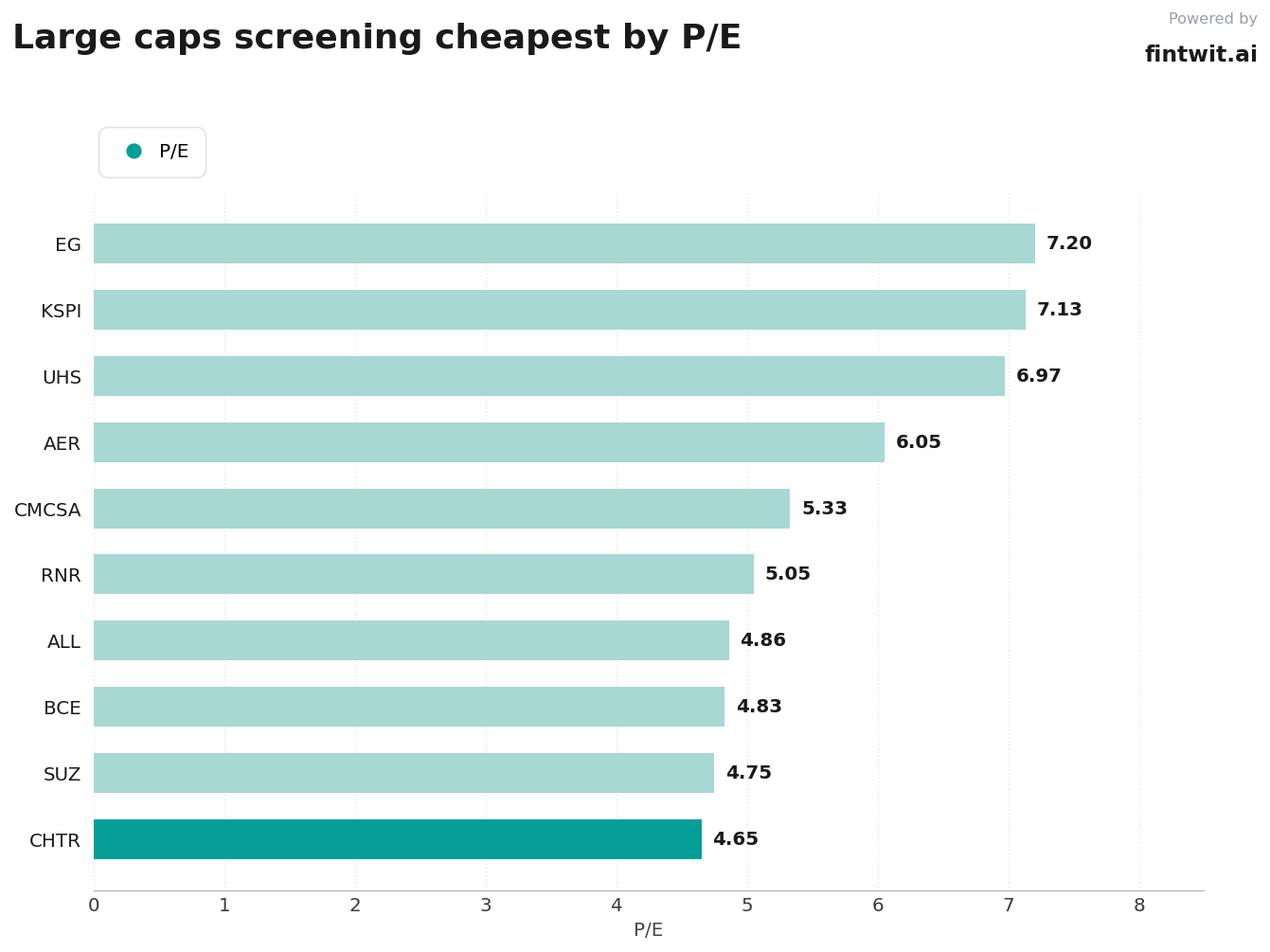
The following companies represent the lowest P/E multiples within our screened universe, each carrying unique fundamental narratives.
Investors should note that low multiples often reflect market skepticism regarding future growth or debt sustainability.
The data below summarizes the valuation and the primary analyst sentiment for each ticker.
- CHTR: 4.65x P/E; persistent broadband losses and $90B debt; Bernstein notes fundamental pressure.
- SUZ: 4.75x P/E; slower deleveraging due to high CapEx; analysts wait for balance sheet improvement.
- BCE: 4.83x P/E; limited growth and utility-like profile; short-term outlook remains negative.
- ALL: 4.86x P/E; improving margins and policy growth; Wolfe Research targets $261.
- RNR: 5.05x P/E; disciplined underwriting performance; market skepticism persists despite strong results.
- CMCSA: 5.33x P/E; cable subscriber decline and streaming losses; analysts cite domestic broadband pressure.
- AER: 6.05x P/E; strong operational performance; sentiment-driven weakness rather than fundamental decay.
- UHS: 6.97x P/E; regulatory and patient safety investigations; significant legal risk overhang.
- KSPI: 7.13x P/E; high-quality business in Kazakhstan; regional macro risks drive extreme discount.
- EG: 7.20x P/E; global reinsurance exposure; investor sentiment remains cautious on P&C insurance.
Caveats
A low P/E ratio is not a guarantee of future performance and frequently indicates a value trap.
Debt levels and interest coverage ratios are critical when evaluating companies like Charter or BCE.
Regulatory and geopolitical risks can permanently impair the earnings power of companies like UHS or KSPI, regardless of the current valuation.
- Earnings quality: High free cash flow yield is necessary to support dividends and debt service.
- Cyclicality: Insurance and commodity-linked stocks like EG and SUZ are prone to earnings volatility.
- Market sentiment: Sector rotation into AI and tech has left traditional industries like telecom undervalued.
- Leverage: High debt-to-equity ratios can compress valuation multiples indefinitely.
How to use this screen
Use this list as a starting point for fundamental research rather than a buy list.
Focus on companies where the low valuation is driven by temporary sentiment shifts rather than permanent structural decline.
Monitor the relationship between free cash flow and earnings to identify potential accounting or operational discrepancies.
- Verify if the low P/E is supported by consistent, positive free cash flow.
- Check for upcoming debt maturities that could force capital structure changes.
- Compare the current P/E ratio against the company's five-year historical average.
- Assess whether the dividend yield is sustainable given the current payout ratio.