Canadian National Railway Company (CNI) Q2 2026 Earnings Preview: What to Watch
Canadian National Railway (CNI) reports Q2 2026 earnings on July 24. Analysts watch grain volumes, U.S. trade tariffs, and capital expenditure shifts.

The setup
Management has maintained a cautious outlook for 2026, guiding for flat overall volume. The company is currently executing a rebalancing of capital expenditure, reducing it by nearly 20% to C$2.8 billion.
This shift follows the completion of major capacity and fleet investments in prior years. Investors are evaluating whether this capital discipline will protect margins despite macroeconomic headwinds.
- Report date: July 24, 2026, before market open.
- Management guidance: Flat volume for the full year 2026.
- Capital expenditure: Reduced by 20% to C$2.8 billion.
- Macro headwinds: U.S. trade tariffs on steel, aluminum, and lumber.
Consensus numbers
Market expectations remain tight as the company navigates uneven Canadian economic growth. Analysts are focused on whether the firm can maintain its historical margin leadership despite a lack of earnings growth over the past decade.
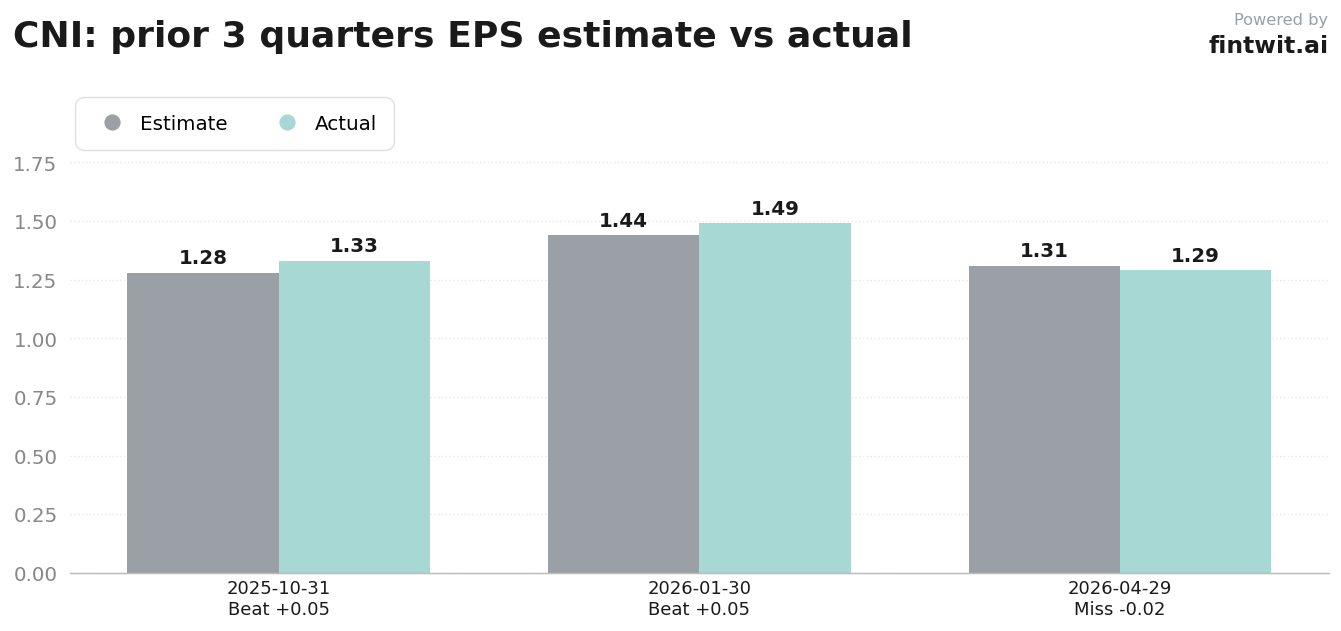
Recent quarterly results show a history of mixed surprises against estimates. The following data highlights the consensus targets and recent performance trends.
- Q2 2026 EPS estimate: $1.39.
- Q2 2026 Revenue estimate: $3.26 billion.
- Citigroup rating: Buy with a $141.00 price target.
- Susquehanna rating: Neutral with a $140.00 price target.
- Citizens rating: Market Perform, citing historical margin concerns.
What we'll watch on the call
The Grain and Fertilizers segment is a primary focus following record-breaking movement in June 2026. Analysts are seeking confirmation that this export demand is sustainable throughout the second half of the year.
The Metals and Minerals segment remains under pressure from U.S. trade tariffs. Investors will monitor if volume declines have stabilized or if trade policy continues to erode cross-border shipment profitability.
Energy and Chemicals demand, particularly for LNG and petroleum, has provided a partial offset to broader industrial weakness. Management commentary on the durability of these commodity trends is critical.
- Impact of U.S. trade tariffs on steel and automotive cross-border volumes.
- Sustainability of June 2026 record-setting grain movement levels.
- Operating margin outlook in the current cost environment.
- Geopolitical risk impact on energy and commodity export demand.
Fintwit's AI verdict
The quantitative models suggest a specific outlook for the upcoming release, balancing the reduced capital expenditure against the potential for volume volatility. While the consensus remains cautious, the underlying operational efficiency metrics provide a distinct perspective on the company's current valuation.
Investors are looking for signs that the recent shift in capital allocation will yield long-term stability. The data points toward a potential divergence between market sentiment and internal performance indicators.