Bank of America (BAC) Q2 Earnings Preview: What to Watch
Bank of America reports Q2 2026 earnings on July 14. Analysts expect $1.13 EPS as the bank navigates interest rate headwinds and capital markets volatility.

The setup
Bank of America management recently raised its full-year 2026 Net Interest Income (NII) growth guidance to a range of 6% to 8%, up from the previous 5% to 7% forecast. This adjustment reflects confidence in the bank's ability to manage asset repricing despite a higher-for-longer interest rate environment.
Operating leverage remains a primary focus for institutional investors. The bank has targeted over 200 basis points of operating leverage for the year, with internal commentary suggesting Q2 could see performance exceeding 400 basis points.
- Erika Najarian of UBS maintains a bullish stance with a $68 price target, citing capital markets and trading momentum.
- Christopher McGratty at Keefe Bruyette holds a $67 price target, noting that fundamental momentum supports continued rotation into the stock.
- Glenn Schorr of Evercore ISI highlights strong equity growth and M&A activity, setting a $63 price target.
Consensus numbers
The market consensus for the second quarter sits at $1.13 per share, a figure that reflects steady upward revisions from analysts over the last 90 days. Revenue estimates are anchored at $30.67 billion, driven by expectations of resilient fee income.
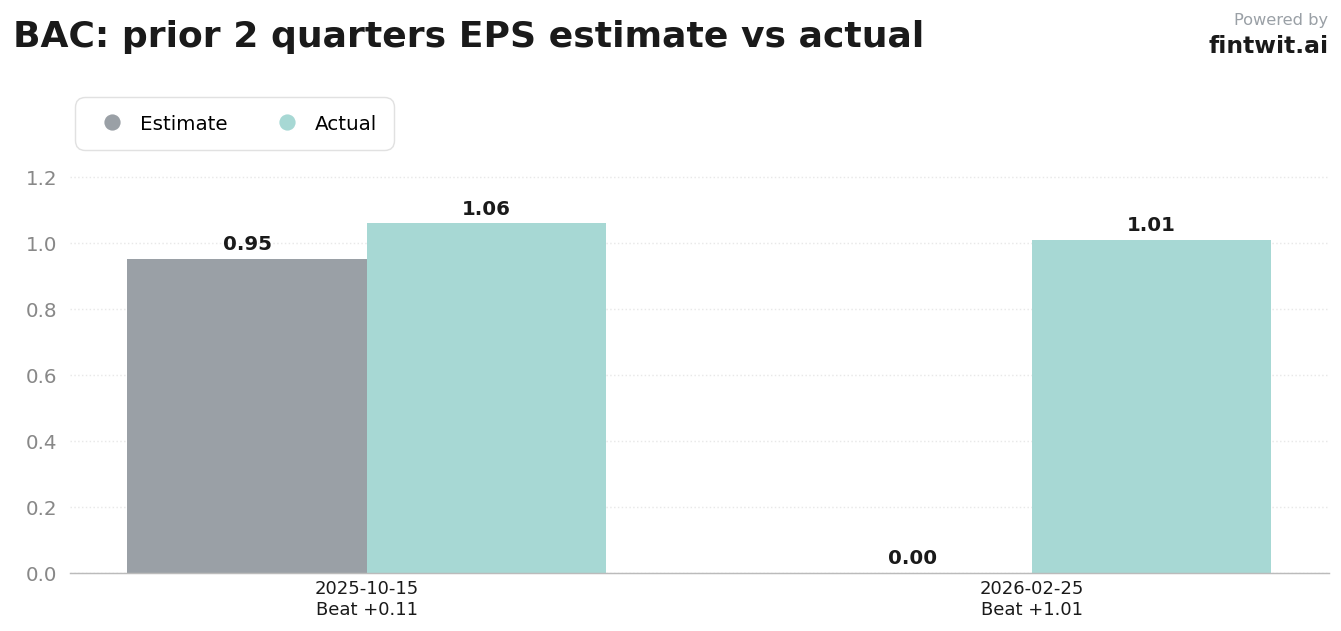
Historical data shows the bank has consistently outperformed expectations, providing a cushion for current valuation levels.
- EPS Estimate: $1.13
- Revenue Estimate: $30.67 billion
- Q4 2025 EPS: $1.06 (vs $0.952 estimate)
- Q1 2026 EPS: $1.01
- Beat Probability: 70%
- Miss Probability: 10%
What we'll watch on the call
Investors are looking for clarity on the sustainability of NII growth as the tailwinds from fixed-rate asset repricing begin to moderate in the second half of the year. The bank's ability to maintain fee income momentum in Global Markets will be a critical indicator of health.
Consumer banking remains a key segment for monitoring credit quality. Any early signs of stress in consumer portfolios could trigger a re-evaluation of credit provision levels.
- Can the bank sustain high-single-digit NII growth as asset repricing tailwinds fade?
- Is the >400 bps operating leverage target achievable given potential variable compensation costs?
- Are there any early signs of credit deterioration in consumer or commercial portfolios?
- How will the bank balance aggressive share buybacks with its CET1 capital buffer targets?
Fintwit's AI verdict
The quantitative models tracking Bank of America suggest a favorable risk-reward profile heading into the mid-July print. The combination of upward estimate revisions and management's aggressive operating leverage targets creates a distinct narrative for institutional participants.
Market participants are weighing the durability of fee-based revenue against the macro uncertainty of unemployment trends. The internal scoring mechanism reflects a high degree of confidence in the current trajectory of the firm's capital allocation strategy.